
Have you ever wondered what the different Mahjong Tiles represent? Did you every want to figure out the significance? How do you use them?
Mahjong, the ancient Chinese game that has entranced players for centuries, is not just about strategy and skill; it’s also a visual and tactile experience. Central to this experience are the beautifully crafted tiles, each with its own symbolism and significance. In this blog post, we delve into the world of Mahjong tiles, exploring their rich history and the deeper meaning they bring to the game.
1. The Composition of Tiles
A Chinese Mahjong sets consist of 144 tiles, divided into different categories:
- Suits: These include the Circles (or Dots), Bamboos (or Bams), and Characters (or Craks), each numbered from one to nine. These tiles are often called the “simple” tiles.
- Honors: The honors tiles consist of the Winds (East, South, West, and North) and the Dragons (Red, Green, and White). These tiles are considered more valuable and carry unique symbolism.
- Bonus Tiles: These tiles, the Flowers and Seasons, are not essential for gameplay but are added for extra layers of excitement in some variations.
2. Symbolism of Tiles
Each category of tiles in Mahjong carries its own symbolism:
- Suits (Circles, Bamboos, and Characters): These represent various aspects of daily life, such as wealth, simplicity, and the written word.
- Honors (Winds and Dragons): These tiles are associated with natural forces and elements. The Winds represent directional forces, while the Dragons symbolize mythical creatures or elements.
- Flowers: These tiles represent the four seasons and the passing of time, often adding an aesthetic and poetic touch to the game.
3. Suit Tiles
a. Circles (筒, tóng): These are often referred to as “dots” in some variations. Circles represent coins or money and are associated with wealth and prosperity.

b. Bamboos (索, suǒ): Also known as “sticks,” these tiles depict bamboo sticks or rods. They symbolize simplicity and tranquility.

c. Characters (萬, wàn): These tiles feature Chinese characters from one to nine, representing various objects and concepts. They are often associated with the everyday aspects of life.

4. The Winds
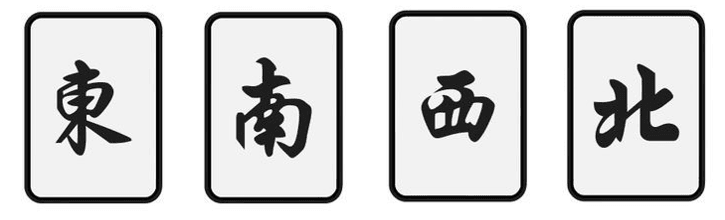
The Winds (East, South, West, and North) are particularly significant in Mahjong:
- East (东 – Dōng): East represents the dealer or the most favorable seat at the table. It’s often associated with the beginning of a new cycle.
- South (南 – Nán): South symbolizes growth and development, making it the second most favorable seat.
- West (西 – Xī): West represents stability and maturity.
- North (北 – Běi): North is associated with old age and decline.
5. The Dragons
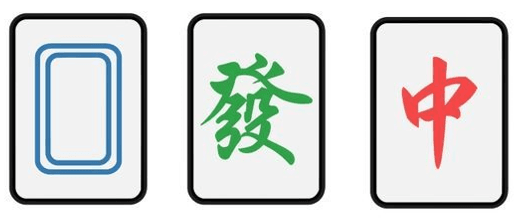
The three Dragon tiles, known as the Red, Green, and White Dragons, have their own unique symbolism:
- Red Dragon (红中 – Hóng Zhōng): The Red Dragon often represents success, good luck, or prosperity.
- Green Dragon (青发 – Qīng Fā): The Green Dragon is linked to the concepts of growth and change, often associated with spring.
- White Dragon (白板 – Bái Bǎn): The White Dragon is related to purity and simplicity.
6. Bonus Tiles
a. Flowers (花, huā): These tiles depict various flowers and are often used as bonus tiles or as part of special combinations. They bring a touch of beauty and grace to the game. Plum (梅), Orchid (蘭), Chrysanthemum (菊) and Bamboo (竹).
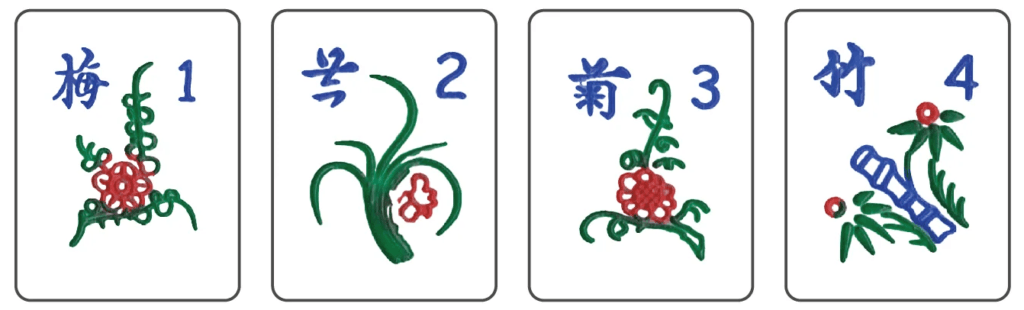
| Plum | Orchid | Chrysanthemum | Bamboo |
| 梅 | 蘭 | 菊 | 竹 |
| méi | lánhuā | júhuā | zhú |
| East | South | West | North |
b. Seasons (季節, jìjié): Similarly, season tiles depict the four seasons—spring (春, chūn), summer (夏, xià), autumn (秋, qiū), and winter (冬, dōng). They add an element of seasonal change to the game.
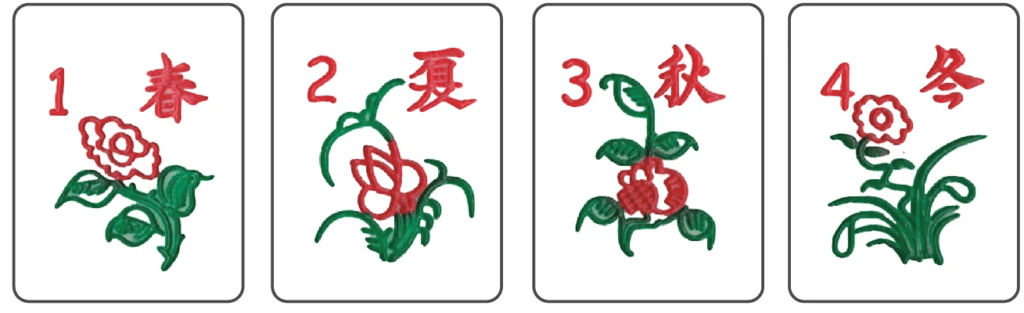
| Spring | Summer | Autumn | Winter |
| 春 | 夏 | 秋 | 冬 |
| chūn | xià | qiū | dōng |
| East | South | West | North |
7. Jokers and Other Variations
In some Mahjong variations (for example Western Mahjong), you might find additional tiles, including jokers or wild cards. These tiles can be used to substitute for others, adding an element of unpredictability to the game.
Mahjong is not just a game; it’s a visual journey through intricate symbolism and meaningful representation. The tiles themselves are like miniature pieces of art, and understanding their deeper significance adds an extra layer of appreciation to the game. The next time you gather around the Mahjong table, take a moment to admire the tiles, appreciate their history, and consider the rich symbolism they bring to this timeless pastime.
Let’s play mahjong 🀄!
Wanting Mahjong Merchandise? We offer unique and personalised offerings.
Learning on a proper table helps. Rent a complete mahjong set — tiles, table and racks, delivered ready to play across Sydney.
More in Beginner's Guides, Information