
Beginner's Guides, Tips & Tricks

Basic Scoring Hands in Mahjong

Once you have set-up Mahjong, dealt the game and finished with replacement tiles (if required), it is time to play!

This post will be the basic scoring for chinese mahjong hands. Please refer to this List of Chinese Mahjong Hands for visuals of each proposed hand.

How to count points:

  1. The points are based on the contents of the winning hand. The points are added up together in a simple sum.
  2. The flowers and season tiles are counted apart from the 8 point minimum.
  3. Depending on the Mahjong (winning by someone’s discard or self-drawn) additional points are added to determine the final score
  4. The score is then translated into payments or point deductions (depending on how you are playing).

Note 1: The one who declares Mahjong is the only one who gets to score points.
Note 2: You must have a minimum of 8 points to call Mahjong or else there is penalty of 30 points (10 to each player).

Example: Win by Self-Drawn
Add 8 points to the value of the winning hand.

The winner receives this amount from each of the 3 opponents.

For example:
If a player wins by a self-drawn tile, with a total points of 10 points + 2 flowers tiles = 12 points.
They will add 8 points to the total, 12 + 8 = 20 points.
Therefore, they will receive 20 chips/points from each player, 20 + 20 + 20 = 60 points.

Therefore, it is a tremendous advantage to finishing a hand self drawn!

Example: Win by someone’s discard
The winner who called Mahjong received 8 points or chips from each of the 3 opponents.

The winner also receives points or chips from the player who discarded the winning tile equal to the points by the winning player.

If a player win’s by someone’s discard with the total for 10 points + 2 flower tiles = 12 points.
Therefore they would receive 8 + 8 + 8 (from each of the opponents) = 24 points + 12 points (from hand) = 36 points.

Therefore the player who discarded the winning tile must give the winning player a grand total of 36 points or chips.
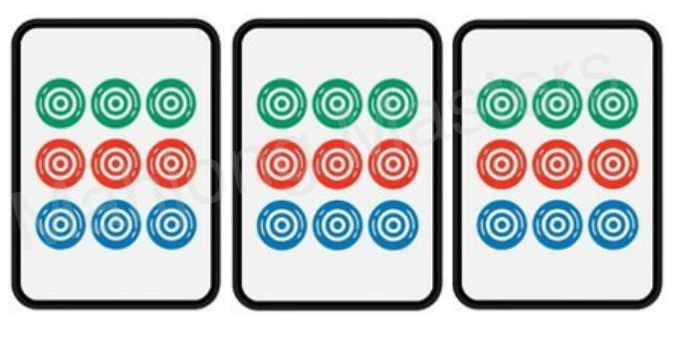
Three identical nine of circles tiles forming a pung

Let’s play mahjong 🀄!

Learning on a proper table helps. Rent a complete mahjong set — tiles, table and racks, delivered ready to play across Sydney.

Share this

Previous Post

Mahjong for Team Building: Using the Game to Foster Communication and Collaboration

In the realm of team building activities, Mahjong may not be the first game that comes to mind. However, this ancient Chinese game offers a unique and effective way to promote communication, collaboration, and teamwork among participants. In this blog post, we’ll explore how Mahjong can be used as a powerful tool for team building, bringing individuals together to develop essential skills and strengthen interpersonal relationships.

The Nature of Mahjong

Mahjong is a game of strategy, skill, and social interaction. Players must work together to achieve a common goal while navigating the complexities of the game board. Each player’s success is intertwined with that of their teammates, requiring effective communication and collaboration to achieve victory.

Key Principles of Mahjong Team Building

  1. Communication: Mahjong encourages players to communicate openly and effectively with their teammates. Discussing strategy, sharing information about tile draws, and coordinating moves are essential components of successful gameplay.
  2. Collaboration: Collaboration is at the heart of Mahjong. Players must work together to identify opportunities, plan their moves, and adapt to changing circumstances. By pooling their collective knowledge and resources, teams can overcome challenges and achieve their objectives.
  3. Problem-solving: Mahjong presents players with a series of challenges that require creative problem-solving skills. Teams must analyze the game board, anticipate their opponents’ moves, and devise strategies to achieve victory. This process fosters critical thinking and encourages participants to explore new approaches to problem-solving.
  4. Trust: Trust is an essential element of Mahjong team building. Players must trust their teammates to make sound decisions and support each other throughout the game. By building trust within the team, participants can collaborate more effectively and achieve greater success.

Benefits of Mahjong Team Building

  1. Improved Communication Skills: Mahjong encourages participants to communicate openly and effectively with their teammates, leading to improved communication skills both within the game and in real-life situations.
  2. Enhanced Collaboration: Mahjong fosters collaboration and teamwork, helping participants develop the skills needed to work effectively with others towards a common goal.
  3. Strengthened Relationships: Mahjong provides a fun and engaging way for participants to bond with their teammates, leading to stronger interpersonal relationships and a sense of camaraderie.
  4. Boosted Morale: Engaging in Mahjong team building activities can boost morale and create a positive work environment, leading to increased motivation and productivity among participants.

Mahjong offers a unique and effective way to promote communication, collaboration, and teamwork among participants. By incorporating Mahjong into team building activities, organizations can help their employees develop essential skills, strengthen interpersonal relationships, and foster a culture of collaboration and mutual support. As teams come together to play Mahjong, they not only have fun but also build the foundation for long-term success and growth.

Let’s play mahjong 🀄!

Hosting soon? Rent a complete mahjong setup delivered across Sydney, or browse our original mahjong merchandise.