Our Blog

Welcome to The Mahjong Masters blog! Where we will try to provide information on mahjong. Everything from basics to some tricks that may come in useful!

List of Chinese Mahjong Hands

Please note that the point values can vary depending on the specific rules you’re playing by.

This post will show you the 81 scoring mahjong hands.

1 point scoring hands
There are 13 hands that score 1 point.

Hand 1. Pure Double Chow – Chow Based
Two Chows (runs) of the same suit and numerical sequence.

Hand 2. Mixed Double Chow
Two Chows (runs) of the same numerical sequence but in two different suits.

Hand 3. Short Straight
Two consecutive Chows in the same suit.

Hand 4. Two Terminal Chows
Two Terminal Chows in the same suit. A Terminal Chow is three consecutive tiles that include either a 1 or a 9.

Hand 5. Pung of Terminal Chows
Each Pung of Terminals (1’s or 9’s) or Honors scores 1 point.

Hand 6. Melded Kong
A Kong claimed from another player or promoted from a melded Pung.

Hand 7. One Voided Suit
A hand is missing one suit entirely, so has either no Characters, no Dots or no Bamboos.

Hand 8. No Honours
A hand entirely made up of suit tiles, with no Honor tiles (but can contain the Terminals).

Hand 9. Edge Wait
A hand waiting for an – only one tile possible to complete the hand. For example, so waiting for a 3 to complete 1-2-3 or a 7 to complete 7-8-9. This scoring hand is invalid if there are any other waits. It is acceptable to have combinations that do not add to the variety of the tiles required, e.g. 7-7-8-9 which is a combination of Edge and Single Wait, but only the 7 can actually complete the hand.

Hand 10. Closed Wait
A hand that goes out on a closed wait, e.g. 4-6 waiting for the 5. If combined with other waits the hand is invalid (e.g. 3-5-5-5 does not count for the Single Wait or Closed Wait). It is acceptable to have combinations that o not add to the variety of tiles required, e.g. 1-2-2-3-4. which is a Closed Wait and Edge Wait but only the 3 can complete the hand.

Hand 11. Single Wait
Going out on a Single Wait is known as finishing a head. Any type of combination wait invalidates the hand. It is acceptable, however, to have combinations that do not add to the variety of tiles required, e.g. 5-6-6-7, which is a Closed Wait and a Single Wait but only the 6 can complete the hand.

Hand 12. Self-Drawn
Going out with a tile drawn from the wall.

Hand 13. Flower Tiles
When a players goes out with the replacement tile drawn for a Flower tile, Self Drawn (one point) is added to the point total for the hand.

2 point scoring hands
There are 10 hands that score 2 points.

Hand 14. Dragon Pung
One Pung of Dragon tiles, that can be melded or concealed.

Hand 15. Pung of Prevalent Wind
A Pung of the Prevalent or Table Wind corresponding to the round of the play in progress. May be concealed or melded.

Hand 16. Pung of Seat Wind
A Pung of the player’s Seat Wind – concealed or melded

Hand 17. Concealed Hand
A player that goes out off another player’s discarded tile and hase a concealed hand with no melded sets.

Hand 18. All Chows
A hand consisting of all Chows and no honour tiles as the pair.

Hand 19. Tile Hog
Using all 4 of a number in a single suit, but without declaring them as a Kong. You cannot count a Concealed Kong or Melded Kong as Tile Hong.

Hand 20. Double Pung
Two Pungs of the same number.

Hand 21. Two Concealed Pungs
Two concealed Pungs (Pungs made without claiming tiles from another player).

Hand 22. Concealed Kong
A Kong made from tiles all drawn from the wall, not claimed from another player.

Hand 23. All Simples
A hand made up of no honour tiles and no terminals.

4 point scoring hands
There are 4 hands that score 4 points.

Hand 25. Outside Hand
A hand with a Terminal or Honor in each element of it, including the pair/head.

It may be combined with:

  • Pure Double Chow
  • Lower Three
  • Tile Hog
  • Double Pung
  • Pung of Terminals or Honors
  • Mixed Double Chow
  • Two Terminal Chows
  • One Voided Suit

Hand 25. Fully Concealed Hand
A hand completed without making any melds, and that draws from the wall to finish.

Hand 26. Two Melded Kongs
A finished hand that contains two claimed Kongs.

Hand 27. Last Tile
Going out with a tile that is the last of its kind. To claim this hand, the tile must be known to all players to be the last of its kind, which means the other 3 tiles need to be in discard piles or used in claimed sets. You cannot add points for robbing the Kong.

6 points scoring hands
There are 7 hands that score 6 points.

Hand 28. All Pungs
A hand consisting of all Pungs (or Kongs) and no Chows.

Hand 29. Half Flush
A hand formed from any of the suits and honours only.

Hand 30. Mixed Shifted Chows
Three runs of Chows, one in each of the three suits, and each one increasing one in number from the start point of the previous Chow.

Hand 31. All Types
A hand where each of the 5 elements is formed by using a different tile type: Characters, Dots, Bamboos, Winds, and Dragons.

Hand 32. Melded Hand
A hand where every element is completed with discarded tiles, so all 4 sets are claimed, and the player goes out off another player on a single wait.

Hand 33. Two Dragons
A hand containing 2 Pungs or Kongs of Dragons.

8 points scoring hands
There are 9 hands that score 8 points

Hand 34. Mixed Straight
A straight (tiles 1 – 9) formed by Chows from all 3 suits.

Hand 35. Reversible Tiles
A hand composed completely of tiles that are vertically symmetrical. These tiles are:
Bamboos: 1, 2, 3, 4, 5, 8, 9
Dots: 2, 4, 5, 6, 8, 9
Dragon: White

Hand 36. Mixed Triple Chow
Three Chows of the same numbers – one in each suit.

Hand 37. Mixed Shifted Pungs
Three Pungs, one in each suit, and one in each being one number higher then the previous Pung

Hand 38. Chicken Hand
This is a hand that should earn zero points, if it were not a special scoring hand. Flower and Season tiles do not count towards this hand they are added as a bonus to the 8 points scored.

Hand 39. Last Tile Draw
A hand that does out from the very last draw of the fame. The scoring hand is not added to the Self-Drawn.

Hand 40. Tile Claim
A hand that goes out from the very last discard in the game.

Hand 41. Out with Replacement Tile
A hand that goes out off the replacement tile drawing for a Kong. It does not apply to replacement tiles drawn for Flowers or Season tiles, only Kongs.

Hand 42. Two Concealed Kongs
A hand that includes 2 concealed Kongs.

Hand 43. Robbing the Kong
Going out by claiming the tile that another player adds to a melded Pung to create a Kong. This is not combined with a Fully Concealed Hand.

12 points scoring hands
Hand 44. Lesser Honour and Knitted Tiles
A hand made out of singles of these tiles only:

  • Any honour tile
  • Suit tiles that belong to a different Knitted sequence (e.g. 1-4-7 of Characters, 2-5-8 of Bamboos, and 3-6-9 of Dots. Each of the 3 suits must belong to a different Knitted Sequence, but not necessarily in the order above.

When finished with 7 Honour tiles, the hand becomes a Greater Honours and Knitted Tiles hands. If the player goes off their own draw, they can combine Fully Concealed. Points for All Types are not added.

Hand 45. Knitted Straight
This is a special Straight not formed by standard Chows, but by 3 different Knitted sequences, e.g. 1-4-7 Dots, 2-5-8 Characters, 3-6-9 Bamboos (not necessarily in this order).

Hand 46. Upper Four
A hand composed of entirely of the upper 4 numbers (6 to 9). The hand implies a point for No Honours.

Hand 47. Lower Four
Similar to the above, but created entirely from tiles in the lower 4 numbers (1 to 4). The hand implies a point for No Honours.

Hand 48. Big Three Winds
A hand that includes a Pung or Kong of each Wind.

16 points scoring hands
Hand 49. Pure Straight
A hand formed of tiles 1 – 9 of any suit in three consecutive Chows.

Hand 50. Three-suited Terminal Chows
A hand made up of:

  • 2 Terminal Chows (1-2-3 and 7-8-9) in one suit.
  • 2 Terminal Chows (1-2-3 and 7-8-9) in a different suit
  • A head of 5’s in the remaining suit

Hand 51. Pure Shifted Chows
This hand is made up of 3 Chows all of one suit, and each one sifted one number up from the previous, or two up – but not both.

Hand 52. All Fives
A hand that involves a number 5 tile in each element.

Hand 53. Triple Pung
Three Pungs of the same number, one of each suit.

Hand 54. Three Concealed Pungs
Three Pungs but concealed, not decalred.

24 points scoring hands
Hand 55. Seven Pairs
A hand made up of seven pairs. This hand will always end with a single wait, and cannot be combined with a Concealed Hand or Single Wait.

Hand 56. Greater Honours and Knitted Tiles
This is a hand composed of 7 single Honours, plus singles belonging to seperate Knitted sequences (for example, 1-4-7 Bamboo’s, 2-5-8 Characters and 3-6-9 Dots). You cannot combine this hand with All Types, Concealed Hand or Single Wait.

Hand 57. All Even
This is a hand composed of Pungs of even numbers (2, 4, 6, 8) and a head of the same. It implies points scored for All Pungs and All Simples.

Hand 58. Full Flush
This is a hand composed entirely of a single suit, and implies a point for No Honours.

Hand 59. Pure Triple Chow
This is a hand formed of three runs of the same numerical sequence in the same suit. It cannot be combined with Pure Shifted Pungs.

Hand 60. Pure Shifted Pungs
This is hand made up of three Pungs of the same suit, each one shifted up one number from the previous one. It cannot be combined with Pure Triple Chow.

Hand 61. Upper Tiles
This is a hand made up of tiles numbers 7, 8 and 9. It implies a point for No Honours.

Hand 62. Middle Tiles
This is a hand made up of tiles numbers 4, 5 and 6. It implies a point for No Honours.

Hand 63. Lower Tiles
This hand is made up only of tiles numbers 1, 2 and 3. It implies a point for No Honours.

32 points scoring hands
Hand 64. Four Shifted Chows
This hand is made up of four Chows all in one suit. Each one is shifted over either 1 or 2 numbers from the previous Chow, but not a combination of both.

Hand 65. Three Kongs
A hand that contains three Kongs, either melded or concealed.

Hand 66. All Terminals and Honours
A hand that consists entirely of Terminals and Honours – 1, 9 and Honour tiles. It implies points for All Pungs and Pung of Terminals or Honours.

48 points scoring hands
Hand 67. Quadruple Chow
This hand is made up of four Chows of the Same numerical sequence in the same suit. It therefore implies points for Pure Shifted Pungs, Tile Hog and Pure Double Chow.

Hand 68. Four Pure Shifted Pungs
This is four Pungs of the same suit, each one shifted up one from the previous.

64 points scoring hands
Hand 69. All Terminals
This is a hand composed entirely of Terminals – 1 and 9 tiles. It cannot be combined with Double Pung or No Honours.

Hand 70. Little Four Winds
This is a hand made up of three Pungs of Winds and a head of the fourth Wind. It implies points for Big Three Winds and can be combined with Prevalent Wind and Seat Wind.

Hand 71. Little Three Dragons
This is a hand that consists of 2 Dragons Pungs and a head of the third Dragon. Points for a individual Dragon Pungs may not be added.

Hand 72. All Honours
This is a hand made up of entirely of Honors. It can be made of Pungs, Kongs, concealed or melded. It can be combined with Dragon Pung and implies points for All Pungs.

Hand 73. Four Concealed Pungs
This hand is made up of 4 Pungs, all of which are unmelded. It cannot be combined with Fully Concealed Hand or All Pungs.

Hand 74. Pure Terminal Chows
This hand consists of two each of the upper and lower terminal Chows in a single suit, plus a pair of 5 in the same suit.

88 points scoring hands
Hand 75. Big Four Winds
A hand made up of Pungs or Kongs of all hour Winds. It cannot be combined with All Pungs.

Hand 76. Big Three Dragons
This is a hand made up of Pungs or Kongs of all three Dragons. It cannot be combined with Dragon Pung.

Hand 77. All Greens
This is a hand made up of Pungs or Kongs of all three Dragons. It cannot be combined with Half Flush.

Hand 78. Nine Gates
This is a handmade up of 1-1-1-2-3-4-5-6-7-8-9-9-9 of one suit, making a nine-sided wait for a 1-2-3-4-5-6-7-8 or 9. It cannot be combined with Full Flush or Pung of Terminals or Honors.

Hand 79. Four Kongs
This is a hand that contains any fours Kongs, concealed or melded.

Hand 80. Seven Shifted Pairs
This is a hand made up from seven pairs in the same suit, each one shifted up from the last. It cannot be combined with Full Flush, Fully Concealed Hand or Single Wait.

Hand 81. Thirteen Orphans
This is a hand entirely made up of singles of any 12 of the terminal (1 and 9) and Honor Tiles, and a pair of the 13th. It cannot be combined with All Tiles, Concealed Hands or Single Wait.


Hoping that these help your game. Let’s play mahjong 🀄!

Singapore Mahjong: Unique Rules and Scoring

Singapore Mahjong is a distinctive and exciting Mahjong variant known for its unique tiles, fast-paced gameplay, and simplified yet strategic scoring system. Popular in Singapore and parts of Southeast Asia, this version blends traditional Chinese Mahjong with local twists that make it accessible for beginners while still rewarding skill and experience.

In this post, we’ll explore what sets Singapore Mahjong apart, including its special tiles, rules, and scoring system.

What Is Singapore Mahjong?

Singapore Mahjong is typically played by four players and is best known for the inclusion of Animal tiles and a relatively straightforward fan-based scoring system. Compared to Hong Kong or Taiwanese Mahjong, Singapore Mahjong focuses on quick wins, visible scoring elements, and lively gameplay.

Tiles Used in Singapore Mahjong

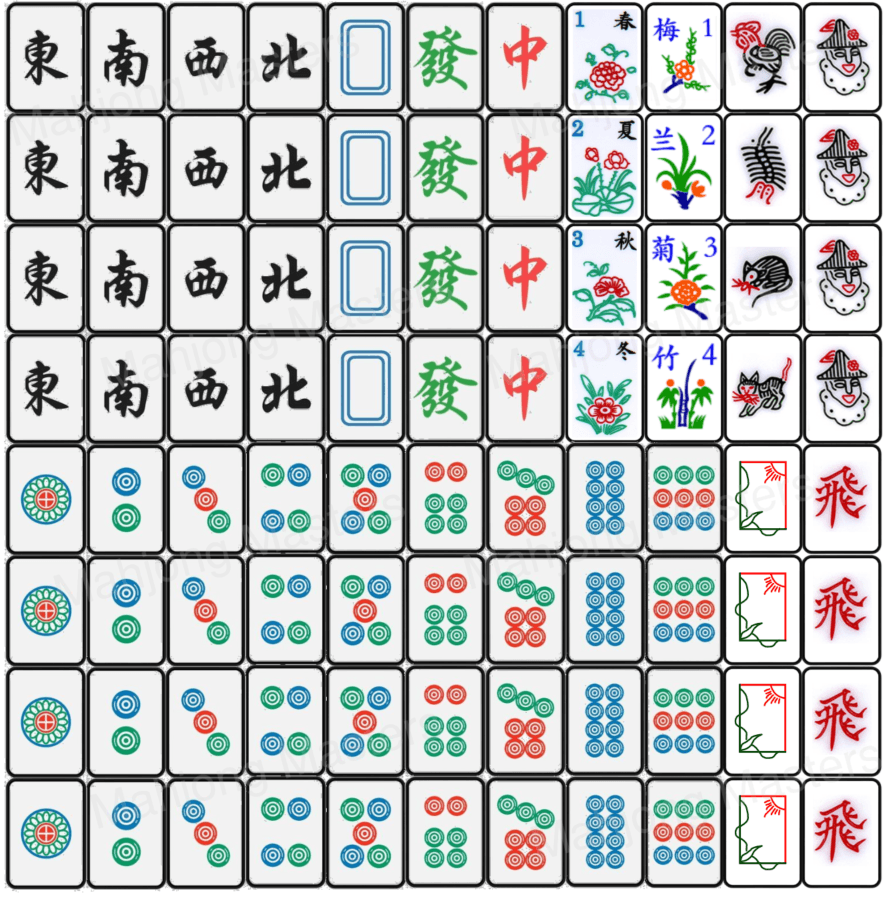
Singapore Mahjong uses the standard 144-tile Mahjong set, plus special tiles that are essential to the game.

Suited Tiles

  • Dots (Circles): 1–9
  • Bamboo (Sticks): 1–9
  • Characters (Wan): 1–9

Each numbered tile appears four times.

Honour Tiles

  • Winds: East, South, West, North
  • Dragons: Red, Green, White

Bonus Tiles (Optional)

  • Flower Tiles
  • Animal Tiles (Cat, Mouse, Rooster, Centipede)

Animal tiles are unique to Singapore Mahjong and play a key role in scoring.

Key Rules That Make Singapore Mahjong Different

Animal Tiles

  • Animal tiles can be used immediately for points and often trigger special payouts. Some animal combinations allow players to collect payments instantly, even before the hand ends.

Simple Winning Structure

A winning hand consists of:

  • 4 sets (Chows, Pungs, or Kongs)
  • 1 pair
  • Total of 14 tiles

This is similar to Hong Kong Mahjong but with different scoring priorities.

Minimum Fan Requirement

Most Singapore Mahjong games require a minimum of 1 fan to declare Mahjong, making it beginner-friendly and fast-moving.

Key Rules That Make Singapore Mahjong Different

Singapore Mahjong uses a fan (point) system, but scoring is generally easier to learn compared to other Mahjong variants.

Common Scoring Elements

  • Self-draw win
  • Pung of Dragons
  • Pung of Seat Wind or Round Wind
  • All Chows
  • All Pungs
  • Half Flush (one suit + honors)
  • Full Flush (one suit only)
  • Flower tiles
  • Animal tiles

Animal and flower tiles are especially important, as each typically scores 1 fan and may come with additional payouts depending on house rules.

Payment Rules (Typical)

  • All players pay the winner
  • Self-draw wins usually receive higher payouts
  • Animal tile bonuses may require immediate payment from all players
  • House rules determine final payout structure

Strategy Tips for Singapore Mahjong

1. Prioritize Bonus Tiles

Animal and flower tiles add quick points and should never be ignored.

2. Play Fast and Flexible

Singapore Mahjong rewards quick decision-making and efficient hands.

3. Watch for Animal Tile Combos

Some animal combinations offer instant rewards—know them well.

4. Don’t Overbuild

Since the minimum fan requirement is low, chasing overly complex hands can slow you down unnecessarily.

Why Players Love Singapore Mahjong

  • Easy to learn and teach
  • Fast-paced and social
  • Unique Animal tile mechanics
  • Great balance of luck and skill
  • Perfect for casual and home games

Singapore Mahjong stands out for its unique Animal tiles, simple scoring, and energetic gameplay. It’s an excellent choice for players who want a Mahjong experience that’s social, exciting, and easy to pick up without sacrificing strategic depth.

If you’re looking to try a Mahjong variant that feels fresh and fun, Singapore Mahjong is well worth learning.

Let’s play mahjong 🀄!

Hong Kong Mahjong Explained: Rules, Scoring, and Strategy

Hong Kong Mahjong is one of the most popular and widely played Mahjong variants in the world. Known for its fast pace, straightforward rules, and emphasis on skill and strategy, it’s often the version people mean when they say “Chinese Mahjong.” Whether you’re new to the game or looking to refine your approach, this guide breaks down the rules, scoring system, and key strategies of Hong Kong Mahjong in a clear and easy-to-follow format.

What Is Hong Kong Mahjong?

Hong Kong Mahjong is a traditional four-player game focused on forming a winning hand made up of four sets and one pair. Compared to other versions like Riichi or American Mahjong, Hong Kong Mahjong uses simpler scoring, fewer restrictions, and allows for flexible play styles.

Tiles Used in Hong Kong Mahjong

A standard Hong Kong Mahjong set includes 144 tiles.

Suited Tiles

  • Dots (Circles): 1–9
  • Bamboo (Sticks): 1–9
  • Characters (Wan): 1–9

Each numbered tile appears four times.

Honour Tiles

  • Winds: East, South, West, North
  • Dragons: Red, Green, White

Bonus Tiles (Optional)

  • Flowers and Seasons (often used for bonus points or house rules)

Basic Rules of Hong Kong Mahjong

Number of Players

  • 4 players

Objective

  • Be the first to complete a legal winning hand of 14 tiles

Starting the Game

  • Each player starts with 13 tiles
  • The dealer (East) starts with 14 tiles and discards first

Turn Structure

  1. Draw one tile from the wall
  2. Discard one tile
  3. Other players may claim the discarded tile for:
    • Chow (left player only)
    • Pung or Kong (any player)
  4. Declare Mahjong when a winning hand is completed

Valid Sets in Hong Kong Mahjong

Chow (Sequence)

  • Three consecutive numbers in the same suit
  • Example: 3–4–5 Bamboo

Pung (Triplet)

  • Three identical tiles
  • Example: Red Dragon ×3

Kong (Quad)

  • Four identical tiles
  • Example: 7 Dots ×4
  • Requires a replacement tile from the dead wall

Pair (Eyes)

  • Two identical tiles
  • Example: East Wind ×2

Winning Hands

A standard winning hand consists of:

  • 4 sets (any combination of Chows, Pungs, or Kongs)
  • 1 pair

Some tables require a minimum point value (often 3 or 4 points) to declare Mahjong.

Hong Kong Mahjong Scoring (Basic Guide)

Hong Kong Mahjong uses a fan (point) system, where different patterns and actions add points to your hand.

Scoring ElementFan
All Chows1
Pung of Dragons1
Pung of Seat Wind1
Pung of Round Wind1
All Pungs3
Mixed One Suit3
Pure One Suit6
Self-Draw Win1
Flower Tile (each)1

Note: Scoring values may vary by house rules. Always confirm before playing.

Payment Rules (Typical)

  • The winner is paid by all players
  • Self-draw wins usually earn higher payouts
  • If a player wins on a discard, the discarder often pays more

Basic Strategy Tips for Hong Kong Mahjong

1. Build Flexible Hands Early

Avoid committing to a single suit too early. Keep multiple options open until the wall reveals more information.

2. Watch Opponents’ Discards

Tracking discarded tiles helps you predict opponents’ hands and avoid dangerous discards late in the game.

3. Balance Speed and Points

Fast hands are tempting, but waiting for higher-value fan combinations can be worth the risk.

4. Know When to Play Defense

If another player looks close to winning, focus on safe discards rather than pushing for points.

5. Use Kongs Wisely

Kongs can increase your score but also reveal information to opponents. Timing is critical.

Why Hong Kong Mahjong Is So Popular

  • Easy to learn, difficult to master
  • Fast-paced and exciting gameplay
  • Strong balance between luck and strategy
  • Ideal for casual games and competitive play

Hong Kong Mahjong offers a perfect blend of accessibility and strategic depth. With straightforward rules, flexible scoring, and endless variation, it’s an excellent choice for both beginners and experienced players. Understanding the rules and scoring system is the first step toward improving your game and enjoying every round.

🀄 Ready to build your winning hand?

Let’s play mahjong 🀄!

Taiwanese Mahjong: What Makes It Different?

Taiwanese Mahjong is a fast-paced, high-scoring, and highly strategic variant of Mahjong that has grown in popularity across Taiwan and among Mahjong enthusiasts worldwide. While it shares a common foundation with other Chinese Mahjong styles, Taiwanese Mahjong stands out for its larger hands, complex scoring, and action-packed gameplay. In this post, we’ll explore what makes Taiwanese Mahjong unique and why many players find it both challenging and rewarding.

What Is Taiwanese Mahjong?

Taiwanese Mahjong is a four-player Mahjong variant that emphasizes bigger hands and higher point totals. Unlike Hong Kong Mahjong, which focuses on efficiency and speed, Taiwanese Mahjong rewards long-term planning, patience, and calculated risk-taking.

One of the biggest differences is the 16-tile hand, making Taiwanese Mahjong feel more strategic and dynamic from start to finish.

Key Differences at a Glance

FeatureTaiwanese MahjongHong Kong Mahjong
Tiles in Hand1613
Winning Hand17 tiles14 tiles
Bonus TilesMandatoryOptional
ScoringHigh fan, complexSimple fan
Game SpeedSlower, strategicFaster

Key Differences at a Glance

Taiwanese Mahjong uses the standard 144-tile set, including:

Suited Tiles

  • Dots (Circles): 1–9
  • Bamboo (Sticks): 1–9
  • Characters (Wan): 1–9

Each numbered tile appears four times.

Honour Tiles

  • Winds: East, South, West, North
  • Dragons: Red, Green, White

Bonus Tiles (Important)

  • Flowers and Seasons
    In Taiwanese Mahjong, bonus tiles are mandatory and contribute significantly to scoring.

Hand Structure in Taiwanese Mahjong

A winning hand consists of:

  • 5 sets (Chows, Pungs, or Kongs)
  • 1 pair
  • 1 extra tile (due to the 16-tile structure)

This structure allows for more elaborate hands and higher scoring opportunities.

Mandatory Minimum Points

Unlike some Mahjong variants, Taiwanese Mahjong usually requires a minimum number of fan (points) to win—commonly 8 fan, though this may vary by table.

This rule prevents extremely low-value wins and encourages players to build meaningful hands.

Scoring System Explained

Taiwanese Mahjong uses a fan-based scoring system, with many opportunities to accumulate points.

Common Scoring Elements

  • Flower tiles (each flower scores points)
  • Seat wind and round wind pungs
  • All Pungs hand
  • Half Flush (one suit + honors)
  • Full Flush (one suit only)
  • Self-draw wins
  • Concealed hands

Because flower tiles and multiple scoring combinations stack, final scores can become very high compared to other Mahjong styles.

Gameplay Pace and Style

Taiwanese Mahjong tends to be:

  • More strategic than fast
  • Focused on hand building over speed
  • Less forgiving of careless discards

Players often spend more time shaping their hands, aiming for high fan combinations rather than quick wins.

Strategy Tips for Taiwanese Mahjong

1. Value Flower Tiles Early

Bonus tiles are essential. Drawing flowers early provides a strong scoring foundation.

2. Plan for High-Value Hands

Low-value hands may not meet the minimum fan requirement, so aim for flushes, all pungs, or concealed hands.

3. Be Patient

Rushing to win often leads to underpowered hands. Patience is rewarded in Taiwanese Mahjong.

4. Track Discards Closely

Because hands take longer to complete, defensive play and tile tracking are even more important.

5. Balance Risk and Reward

Big hands can pay off—but exposing too much information can invite defensive play from opponents.

Why Players Love Taiwanese Mahjong

  • Deeper strategy and longer games
  • Higher scoring and bigger wins
  • More complex decision-making
  • Greater emphasis on skill over speed

For players who enjoy planning, calculation, and strategic depth, Taiwanese Mahjong offers an incredibly rewarding experience.

Taiwanese Mahjong stands apart from other Mahjong variants due to its 16-tile hands, mandatory bonus tiles, and high-scoring gameplay. While it may feel intimidating at first, mastering Taiwanese Mahjong opens the door to one of the most strategic and exciting versions of the game.

If you’re ready to move beyond basic Mahjong and explore a deeper challenge, Taiwanese Mahjong is well worth learning.

Let’s play mahjong 🀄!

Basic Scoring Hands in Mahjong

Once you have set-up Mahjong, dealt the game and finished with replacement tiles (if required), it is time to play!

This post will be the basic scoring for chinese mahjong hands. Please refer to this List of Chinese Mahjong Hands for visuals of each proposed hand.

How to count points:

  1. The points are based on the contents of the winning hand. The points are added up together in a simple sum.
  2. The flowers and season tiles are counted apart from the 8 point minimum.
  3. Depending on the Mahjong (winning by someone’s discard or self-drawn) additional points are added to determine the final score
  4. The score is then translated into payments or point deductions (depending on how you are playing).

Note 1: The one who declares Mahjong is the only one who gets to score points.
Note 2: You must have a minimum of 8 points to call Mahjong or else there is penalty of 30 points (10 to each player).

Example: Win by Self-Drawn
Add 8 points to the value of the winning hand.

The winner receives this amount from each of the 3 opponents.

For example:
If a player wins by a self-drawn tile, with a total points of 10 points + 2 flowers tiles = 12 points.
They will add 8 points to the total, 12 + 8 = 20 points.
Therefore, they will receive 20 chips/points from each player, 20 + 20 + 20 = 60 points.

Therefore, it is a tremendous advantage to finishing a hand self drawn!

Example: Win by someone’s discard
The winner who called Mahjong received 8 points or chips from each of the 3 opponents.

The winner also receives points or chips from the player who discarded the winning tile equal to the points by the winning player.

If a player win’s by someone’s discard with the total for 10 points + 2 flower tiles = 12 points.
Therefore they would receive 8 + 8 + 8 (from each of the opponents) = 24 points + 12 points (from hand) = 36 points.

Therefore the player who discarded the winning tile must give the winning player a grand total of 36 points or chips.

Let’s play mahjong 🀄!

How to Style a Mahjong Night for Instagram

Mahjong nights aren’t just about gameplay anymore—they’re social, stylish, and highly shareable.

Choose a Statement Mahjong Set

Opt for:

  • Pastel or translucent tiles
  • Gold-foil or engraved designs
  • Coordinated racks and dice

Table Styling Tips

  • Use linen or neutral tablecloths
  • Add candles or soft lighting
  • Match snacks to your color palette

Capture the Moment

  • Flat-lay tile shots
  • Mid-game candid photos
  • Overhead table angles

A beautifully styled Mahjong night turns a classic game into a modern social experience.

Let’s play mahjong 🀄!