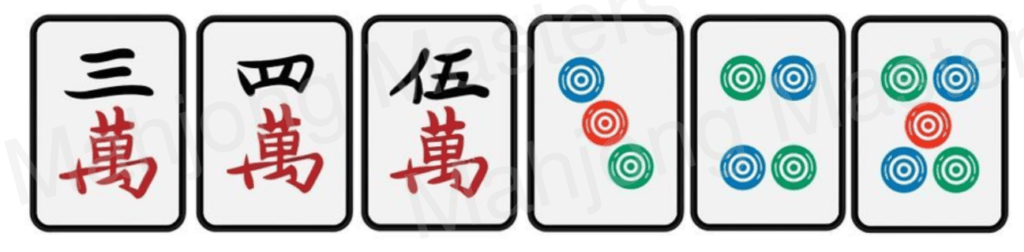
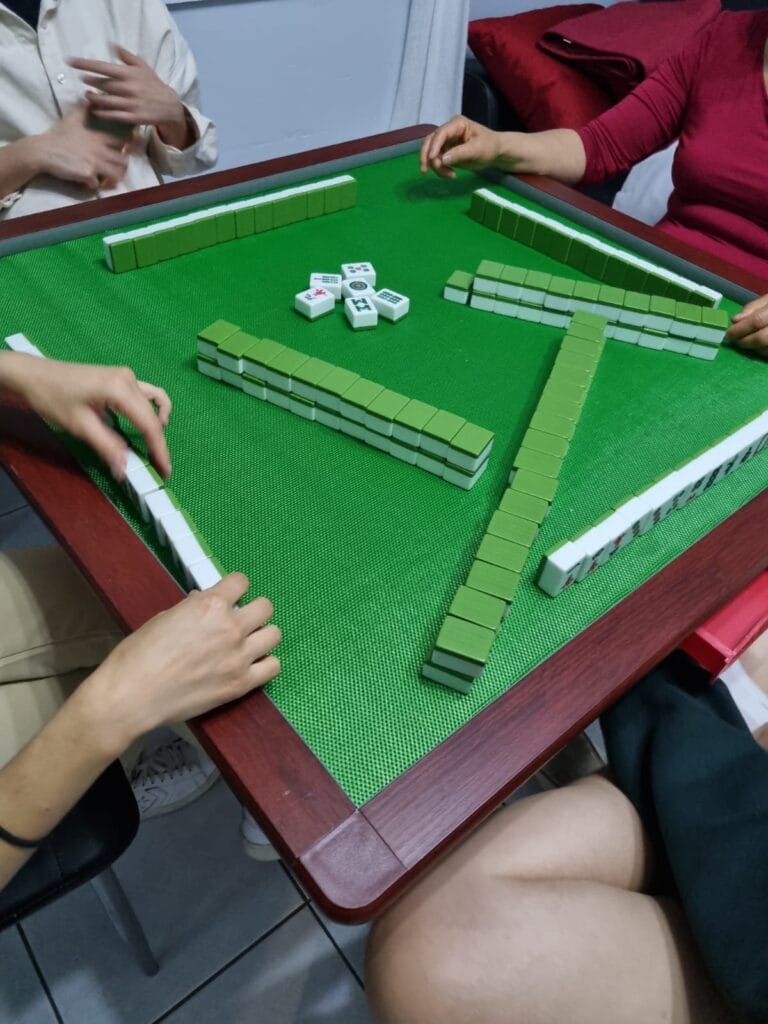
Welcome to The Mahjong Masters blog! Where we will try to provide information on mahjong. Everything from basics to some tricks that may come in useful!
5 Tips for Winning at Western Mahjong
Western Mahjong, with its distinct rules and gameplay compared to Chinese Mahjong, offers a unique challenge to players seeking victory. Success in Western Mahjong requires a blend of strategic thinking, adaptability, and a solid understanding of the game’s mechanics. In this blog post, we’ll explore the top five tips to enhance your chances of triumphing at the Western Mahjong table.
1. Understand the Rules:
One of the foundational elements of winning at Western Mahjong is a thorough understanding of the rules. Familiarize yourself with the specific rule set you are playing, whether it’s American Mahjong, Wright-Patterson Mahjong, or another variation. Knowing the rules ensures that you make informed decisions, understand scoring opportunities, and can adjust your strategy accordingly.
2. Plan Your Hand Strategically:
Western Mahjong often involves the creation of specific hands or sets. Plan your hand strategically from the beginning of the game. Understand the different combinations that can lead to victory, and be adaptable based on the tiles you draw and those discarded by opponents. Flexibility is key to adjusting your strategy as the game progresses.
3. Master the Art of Discard Reading:
Discard reading is a valuable skill in Western Mahjong. Pay close attention to the tiles discarded by your opponents, as this can provide insights into their potential hands. Adjust your strategy based on the discards, and be mindful of giving away tiles that could benefit your opponents. Discard with purpose to disrupt your opponents’ plans while advancing your own.
4. Play Defensively and Offensively:
Striking the right balance between defensive and offensive play is essential in Western Mahjong. While working towards your own winning hand, be aware of potential threats from other players. Don’t be afraid to modify your strategy to prevent opponents from completing strong hands. A mix of defensive and offensive play is crucial for success.
5. Utilize Jokers and Special Tiles Wisely:
In some Western Mahjong variations, jokers or special tiles may be introduced, adding an element of unpredictability. Understand the rules governing these unique tiles and use them strategically to your advantage. Incorporate jokers into your plans to complete combinations or thwart opponents. However, be mindful that others can also leverage these special tiles.
Winning at Western Mahjong is a rewarding journey that combines strategic thinking, adaptability, and a solid grasp of the game’s nuances. By understanding the rules, planning your hand strategically, mastering the art of discard reading, playing both defensively and offensively, and utilizing jokers wisely, you can enhance your chances of emerging victorious at the Western Mahjong table. As you refine your skills and enjoy the twists and turns of the game, Western Mahjong will become not just a pastime but a captivating adventure.
Are you a master at both Western and Chinese Mahjong? If so, leave a comment below.
Not every Mahjong hand starts strong. Knowing how to recover from a poor opening draw can save points, and sometimes turn a losing hand into a surprise win.
Step 1: Stay Flexible
Avoid committing to a hand too early. A bad start often improves after several draws.
Step 2: Drop Isolated Tiles
Single tiles with no matching neighbors should be discarded early to free space.
Step 3: Switch Goals
If a high-value hand is unrealistic:
Aim for a fast, low-point win
Shift toward a defensive posture
Step 4: Watch the Table
Let opponents’ discards guide your new direction. Sometimes the table offers a second chance.
A bad start doesn’t mean a bad round. Strong Mahjong players adapt rather than panic.
Mahjong and Poker are often compared due to their strategic depth and use of probability. But which game truly requires more skill?
Skill Elements in Mahjong
Tile efficiency
Memory and observation
Defensive play
Long-term probability management
Skill Elements in Poker
Bluffing and psychology
Betting strategy
Probability calculation
Reading opponents
Key Differences
Aspect
Mahjong
Poker
Hidden Information
Moderate
High
Memory
High
Low
Luck Factor
Medium
Medium
Long-Term Skill
Very High
Very High
Verdict
Mahjong emphasizes memory and pattern recognition, while Poker focuses more on psychology and betting strategy. Both games reward skill heavily—but in different ways.
Rather than asking which is harder, the better question is which skill set you enjoy using more.
Knowing when to push for a win; and when to play safe, is one of the hardest skills in Mahjong. Strong players don’t always chase big hands; they know when survival matters more than points.
When to Take Risks
Consider playing aggressively if:
Your hand is already well-formed
You’re one tile away from winning
The point value justifies the danger
Opponents appear far from completion
When to Play Safe
Switch to defense if:
Multiple opponents are calling tiles
Late-game discards feel risky
You’re far from a winning hand
You’re leading in points overall
Balancing the Two
Good Mahjong isn’t all offense or defense – it’s knowing when to switch. A safe discard may cost you a win, but a reckless discard can cost you the entire round.
Winning Mahjong over the long term is about minimizing losses as much as maximizing wins.
Advanced Mahjong strategies go beyond the basic principles and involve more complex tactics and decision-making. These strategies are often employed by experienced players who have a deep understanding of the game’s mechanics and are looking to gain an edge over their opponents. When I play against my partner’s mum and siblings, here are some advanced Mahjong strategies I consider:
Tile Reading: Advanced players become adept at reading the game by paying close attention to the tiles that have been discarded by opponents and those that are visible on the table. This helps in deducing the likely composition of opponents’ hands and adjusting their own strategy accordingly.
Counting Tiles: Skilled players may attempt to count the unseen tiles in the wall and their opponents’ hands. This allows them to make more informed decisions about which tiles to discard and which ones to keep based on tile probability.
Psychological Play: Advanced players can employ psychological tactics to mislead opponents. They might intentionally discard tiles that are not part of their desired hand to create confusion or pretend to be aiming for a different winning combination.
Risk Management: Managing risk becomes more crucial at an advanced level. Skilled players assess the potential rewards of making aggressive moves like declaring Riichi or pursuing rare high-scoring hands versus the risks of not completing their hand and losing points.
Aiming for High-Value Hands: Advanced players often target more complex and higher-scoring hands, even if they are riskier. These hands can lead to significant point gains when won.
Baiting Opponents: Players with a deep understanding of the game may set traps by discarding tiles that seem safe but could complete their opponents’ hands. This tactic involves predicting how opponents will react to your discards.
Adapting to the Table: The advanced player should be flexible and adapt to the table dynamics. If a player is far ahead in points, the strategy might shift to defensive play to prevent others from catching up.
Defensive Strategies: Understanding the flow of the game and recognizing when to play defensively is crucial. This might involve avoiding high-risk moves and aiming for a modest but more reliable win.
Time Management: Advanced players often have a good sense of when to push for a quick win and when to slow the game down to their advantage. They may strategically choose to play conservatively when they are leading.
Mind Games: Beyond just tile reading, experienced players may engage in subtle psychological warfare, trying to influence their opponents’ decisions or provoke them into making mistakes.
Study of Yaku and Hands: Learning the various yaku (scoring elements) and winning combinations is essential. Advanced players have a comprehensive knowledge of the different hands they can aim for and how to assemble them.
Analyzing Statistical Data: In online Mahjong or tournaments, players may analyze statistical data from their games, such as the frequency of specific tiles or opponents’ tendencies, to refine their strategies.
Remember that becoming an advanced Mahjong player takes time and practice. These strategies are not to be applied in isolation but rather as part of a holistic approach to the game. Continuous learning and adapting to different situations at the table are key elements of advanced Mahjong play.
What are your strategies and tips? Let me know in the comments section below.
Mahjong Set Maintenance Tips: Ensuring Longevity and Optimal Gameplay
A Mahjong set is more than just a collection of tiles; it’s a cherished companion that weaves memories and stories with each clack of the tiles. To ensure that your Mahjong set stands the test of time and provides optimal gameplay, proper maintenance is crucial. In this blog post, we’ll explore practical Mahjong set maintenance tips that will not only enhance the lifespan of your set but also contribute to an enjoyable gaming experience.
1. Handle with Clean Hands:
The oils, dirt, and residue from our hands can accumulate on the surface of Mahjong tiles over time, affecting their appearance and texture. Before each game, ensure that your hands are clean to prevent unnecessary buildup.
2. Storage Matters:
Store your Mahjong set in a cool, dry place away from direct sunlight. Prolonged exposure to sunlight can cause fading, especially in sets with painted or engraved designs. A protective case or box can help shield the tiles from dust and potential damage.
3. Regular Cleaning:
Dust and debris can settle on the tiles, affecting both their appearance and the smoothness of play. Use a soft, dry cloth to gently wipe the tiles before and after each use. For stubborn stains, a slightly damp cloth can be used, but avoid excessive moisture.
4. Avoid Extreme Temperatures:
Mahjong tiles are often made of materials like wood, plastic, or bakelite, which can be sensitive to extreme temperatures. Avoid exposing your Mahjong set to sudden temperature changes, and never store it in places prone to extreme heat or cold.
5. Rotate Tile Usage:
In a Mahjong set, certain tiles may be used more frequently than others, leading to uneven wear. To ensure that all tiles age uniformly, consider rotating the tiles periodically, especially if you notice some tiles showing signs of wear.
6. Be Mindful of Sharp Edges:
Tiles with sharp edges can detract from the tactile pleasure of handling them and may also cause damage to the table surface. If you notice any rough edges on your tiles, consider using a fine-grit sandpaper to smooth them out.
7. Inspect for Damage:
Regularly inspect your Mahjong set for any signs of damage, such as cracks, chips, or loose pieces. Addressing these issues promptly can prevent further deterioration and ensure the longevity of your set.
8. Keep Away from Food and Drinks:
Accidents happen, but food and drinks can pose a serious threat to your Mahjong set. Spills not only stain the tiles but can also damage the material. Establish a rule of keeping food and drinks away from the Mahjong table.
9. Maintain the Case or Box:
If your Mahjong set comes with a case or box, ensure that it remains in good condition. A sturdy case protects the tiles during storage and transportation. Clean the case regularly, and repair or replace it if necessary.
10. Handle Tiles Carefully:
While Mahjong is a game of strategy, the tiles themselves are delicate. Avoid aggressive shuffling or forcefully slamming tiles onto the table. Treat your Mahjong tiles with the same care you would afford any valuable possession.
Your Mahjong set is not just a game accessory; it’s a treasure that holds countless moments of joy and camaraderie. By following these maintenance tips, you can ensure that your Mahjong set not only endures but continues to enhance your gaming experiences for years to come. Remember, a well-maintained Mahjong set isn’t just a collection of tiles; it’s a legacy that unfolds with each game played and shared.
If you’re new to Mahjong, you might wonder how long a game actually takes. The answer depends on the version played and the experience level of the players.
Average Game Length
Casual Mahjong: 1–2 hours
Competitive Mahjong: 2–4 hours
Single Hand/Round: 5–15 minutes
Factors That Affect Game Time
Ruleset (Chinese, Riichi, Western)
Number of players
Scoring complexity
Player experience
Tips for Faster Games
Use simplified scoring
Limit rule discussions mid-game
Play timed rounds
Mahjong is flexible—you can enjoy quick sessions or long, strategic games depending on your group’s preferences.
Frequently Asked Questions
How long does a game of mahjong take?
A casual game usually runs 1–2 hours. Competitive play takes longer, typically 2–4 hours. A single hand or round finishes in about 5–15 minutes.
How long is a single hand of mahjong?
A single hand or round takes roughly 5 to 15 minutes, depending on how quickly players discard and how much scoring discussion happens at the table.
What makes a mahjong game run longer?
Four things: the ruleset you play (Chinese, Riichi or Western), the number of players, how complex the scoring is, and how experienced everyone at the table is.
How can we finish a mahjong game faster?
Use simplified scoring, settle the rules before you start so play is not interrupted by mid-game discussion, and play timed rounds.
Is Online Mahjong Fair? AI, RNG, and Cheating Explained
Many players wonder whether online Mahjong is truly fair. With AI opponents, random number generators, and the possibility of cheating, it’s a valid concern. Let’s break down how fairness works online.
How RNG Works in Online Mahjong
Online Mahjong uses Random Number Generators (RNGs) to shuffle tiles digitally. Reputable platforms:
Use certified RNG algorithms
Ensure unpredictable tile distribution
Prevent manipulation during games
AI Players Explained
AI opponents are often used to:
Fill empty seats
Help beginners practice
Maintain fast matchmaking
Good platforms clearly label AI players and balance their difficulty.
Cheating: How Common Is It?
Common concerns include:
Collusion between players
Use of bots
Exploiting software bugs
Top platforms combat this through:
Behavior tracking
Reporting systems
Automated detection tools
While no system is perfect, reputable Mahjong platforms invest heavily in fairness. Choosing well-known services significantly reduces risk.
Mahjong is often associated with money—but does that make it gambling? Or is it fundamentally a strategy game?
My parents used to call anything associated with cards as ‘gambling’ including Microsoft computer games ‘Hearts’ and ‘Solitaire’. I didn’t learn how to play mahjong until my 18th birthday, when a friend bought over a mahjong tile set!
Why People Call Mahjong Gambling
Monetary stakes
Risk-reward decisions
Cultural traditions
Why Mahjong Is a Strategy Game
Mathematical probability
Long-term decision-making
Defensive play
Skill-based consistency
The Reality (Truth)
Mahjong is:
A strategy game that can include gambling (if you wish)
Not gambling by definition
Comparable to poker or bridge
The game itself is neutral – how it’s played defines the experience.
Mahjong’s beauty lies in its balance: luck creates excitement, while skill creates mastery. Whether you play casually, competitively, or for stakes, Mahjong remains one of the most intellectually rich games in the world.
Mahjong Terminology Explained: Common Words Every Player Should Know
Mahjong comes with its own language, and learning the terminology makes the game far less intimidating. At first, the unfamiliar words can feel like a barrier—but once you understand them, the game becomes clearer, smoother, and far more enjoyable.
Think of Mahjong terminology like learning basic phrases in a new language. You don’t need to be fluent on day one, but knowing the essentials makes everything easier.
Below is a simple breakdown of common Mahjong terms every player should know.
Essential Mahjong Terms
Chow: A sequence of three consecutive tiles in the same suit (e.g., 3-4-5 Numbers or 3-4-5 Dots). Chows can usually only be claimed from the player immediately before you, making timing and position important.
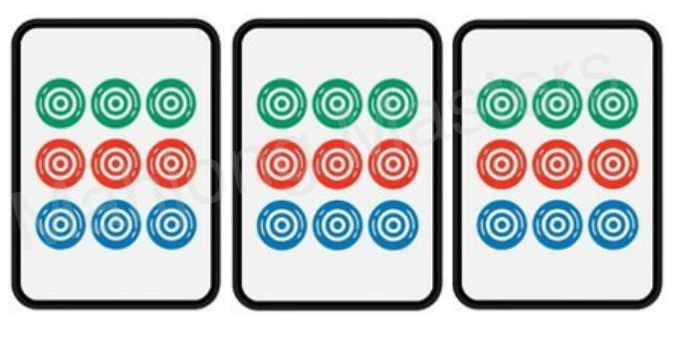
Pung: Three identical tiles (e.g., three Red Dragons or three 7 Dots or three Direction Tiles). Pungs are powerful because they’re easy to recognize and often score points in many Mahjong variations.
Kong: Four identical tiles. Often allows an extra draw. Declaring a Kong usually allows you to draw an extra tile, but it also reveals valuable information to your opponents. Deciding when to declare a Kong is both a tactical and strategic choice.
Pair (Eyes): Two identical tiles needed to complete a winning hand. Choosing the right pair can make the difference between a fast win and a stalled hand.
Meld: Any declared set (Chow, Pung, or Kong). A meld refers to any declared set: Chow, Pung, or Kong – that is exposed on the table. Melds speed up your hand but reduce concealment, which can make you easier to read.
Concealed Hand: A hand made without calling tiles from others. These hands are harder to read and often score higher in many rule sets.
Discard: A tile thrown into the center after drawing. Discards provide crucial information about opponents’ intentions.
Wall: The stacked tiles from which players draw. Watching how the wall shrinks helps experienced players gauge how close the game is to ending.
Why Terminology Matters
Understanding Mahjong terms:
Speeds up gameplay
Prevents confusion at the table
Helps you follow strategy discussions
Makes learning new variations easier
Learning Mahjong vocabulary is like learning chess notation, it unlocks deeper understanding and enjoyment of the game. Once the language clicks, Mahjong transforms from a mysterious pastime into a strategic and social experience.
Rare Mahjong Variations You’ve Probably Never Heard Of
Most players are familiar with popular versions like Hong Kong, Riichi, or American Mahjong. But beyond these well-known styles lies a fascinating world of rare Mahjong variations—each shaped by local culture, history, and creativity.
These lesser-known versions offer fresh challenges and unique twists that can completely change how the game feels.
Vietnamese Mahjong
Vietnamese Mahjong features beautifully ornate tiles, often including special character tiles (flowers and jokers) and larger hand sizes. The game emphasizes visual artistry and complex scoring, making it both challenging and visually striking.
This version is especially popular among players who enjoy deeper calculation and decorative aesthetics.
There are also differences between the ‘classic’ and ‘modern’ Vietnamese Mahjong tile set.
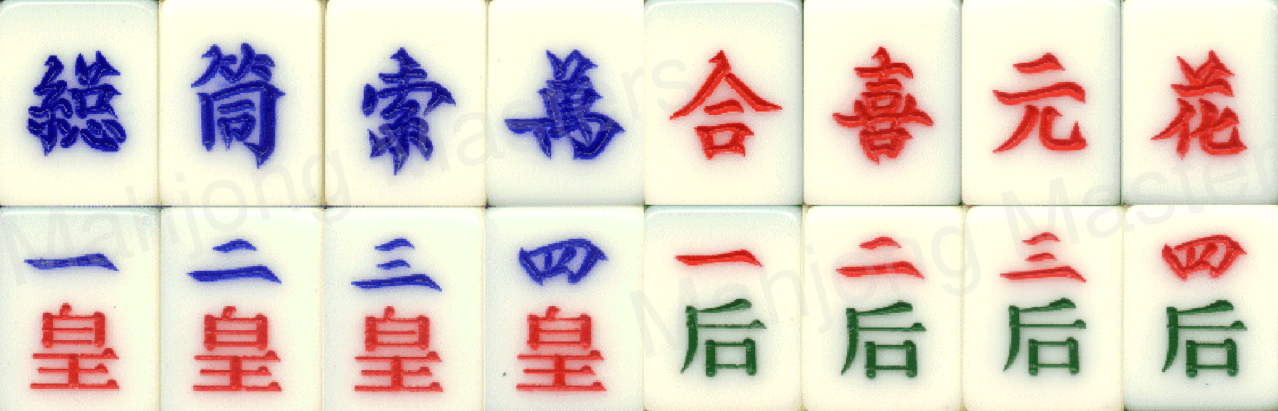
Classic A classic 160-tile Vietnamese set uses the standard 144-tile set with 16 additional tiles. The 16 additional tiles comprise of 8 Vietnamese jokers are at shown on the top row, and the 4 kings and 4 queens at lower row.
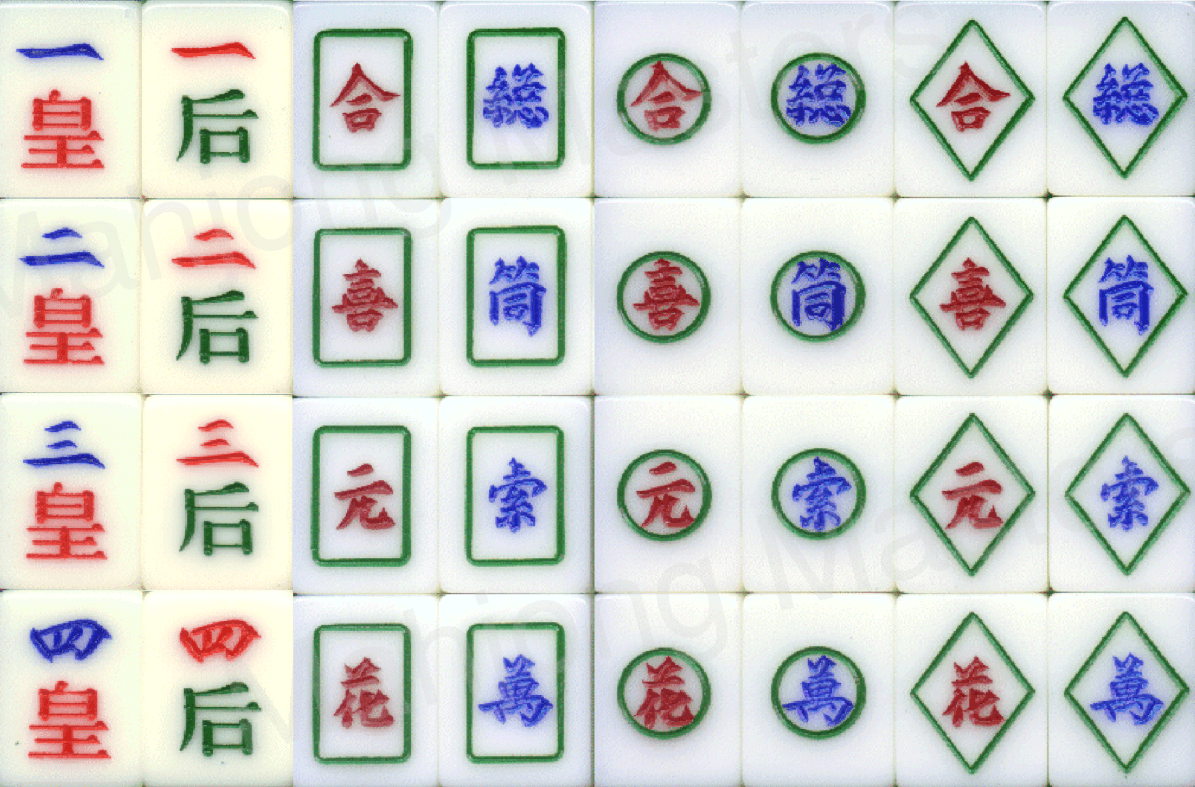
Modern A modern 176-tile Vietnamese set has 24 jokers (the 8 jokers of the Vietnamese classic set, triplicated. Each joker set is outlined by circular, rectangular, or diamond shapes), along with the 4 kings and 4 queens.
Extra Tiles Some players use a 177th tile, which is a combined ‘Wind and Dragon’ joker. For the ease of manufacturer’s to make an even set, it often comes with a 178th tile which is a extra ‘Big Flower’.
Sichuan Bloody Mahjong
Sichuan Bloody Mahjong is fast, aggressive, and chaotic – in the best way possible. Unlike most versions, players continue playing even after someone wins. Multiple players can win in the same round, leading to dramatic, high-energy endings.
This variation rewards bold play and quick decision-making.
Designed for three players instead of four, this version uses fewer tiles and faster rounds. With less information available, efficiency and adaptability become critical.
It’s perfect for smaller groups and players who enjoy rapid gameplay.
Generally, a Malaysian Mahjong tile set contains 88 tiles, but only 84 are needed.
Special Tiles
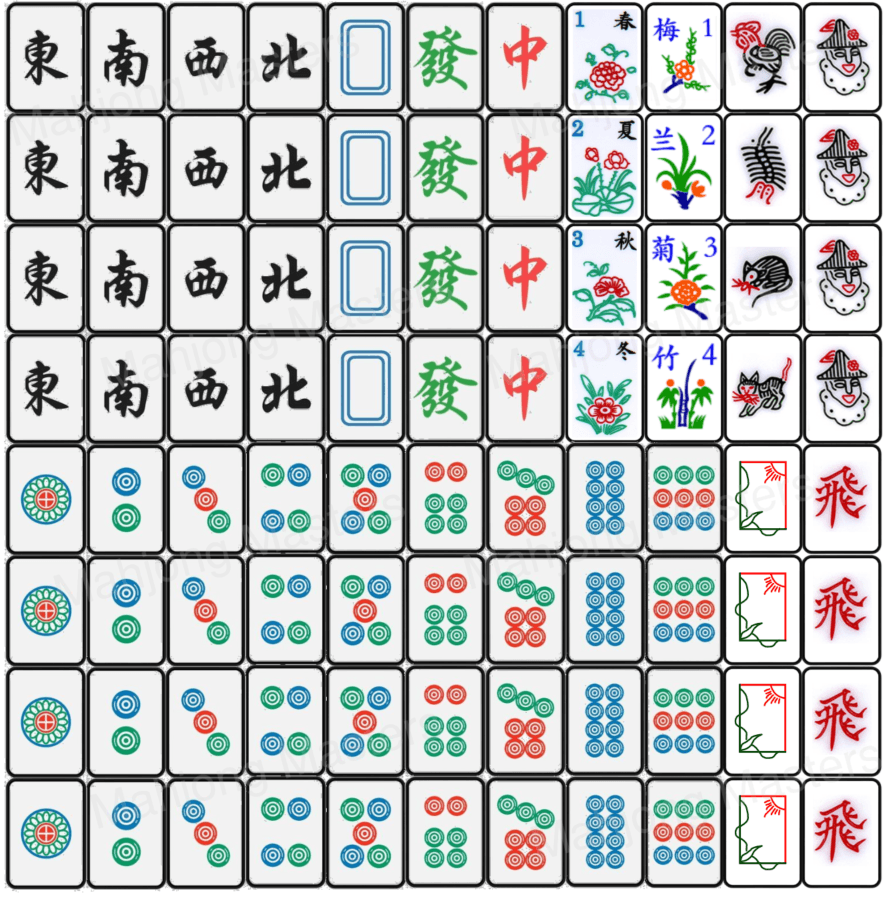
Malaysian Mahjong uses the same ‘flower’ and ‘season’ tiles, with addition of the red ‘fly’ tile, the ‘face’ tile, and the ‘animal tiles’.
The Fly Tiles are used like Jokers. The Face Tiles and Animal tiles are used like Flowers. The green and red Rectangular Tile can be used as White Dragons.
Shanghainese Mahjong
Shanghainese Mahjong strips the game down to its essentials. With fewer tiles, simpler rules, and rapid rounds, it’s often recommended as a beginner-friendly version.
Despite its simplicity, it still rewards sharp observation and smart tile management.
Shanghainese Mahjong uses the standard 144-tile standard Mahjong set (Cracks, Bamboos, Dots, Dragons, Winds, and Flowers).
Filipino Mahjong
Filipino Mahjong blends traditional Mahjong mechanics with card-game elements and strong betting dynamics. It’s highly social and competitive, often played in lively group settings.
This variation highlights Mahjong’s adaptability and cultural evolution.
Filipino Mahjong uses the standard 144-tile standard Mahjong set (Cracks, Bamboos, Dots, Dragons, Winds, and Flowers).
Why Explore Rare Variants?
Trying different Mahjong styles:
Keeps gameplay fresh
Sharpens adaptability
Expands strategic thinking
Deepens appreciation for the game’s history
Exploring rare variants reminds players that Mahjong isn’t a single game. It’s a global family of games connected by shared roots and endless creativity.
Are you aware of other mahjong variations that we haven’t spoken about yet? Please comment about them below!
As our world increasingly embraces the digital realm, so too has the age-old game of Mahjong. Online Mahjong platforms have emerged as a vibrant hub for enthusiasts, both seasoned players and newcomers. In this blog post, we explore the burgeoning popularity of online Mahjong, delving into the advantages and disadvantages of this digital evolution.
The Advantages of Online Mahjong
1. Accessibility: Online Mahjong platforms break down geographical barriers, allowing players from around the world to come together in virtual rooms. This accessibility broadens the player base and enables enthusiasts to find games whenever they desire, day or night.
2. Variety of Rulesets: Online Mahjong platforms often offer a wide range of rule sets and variations, catering to players with different preferences. Whether you prefer Chinese, Japanese, or Western Mahjong, you’re likely to find a platform that suits your style.
3. Skill Development: Online play provides an opportunity for players to test their skills against a diverse array of opponents. This diversity can accelerate skill development, as players encounter various strategies and styles of play.
4. Time Flexibility: Digital Mahjong accommodates busy schedules. Players can engage in quick matches or longer gaming sessions, fitting gameplay into their available time slots.
5. Enhanced Learning: Online platforms may include tutorials, practice modes, and AI opponents, making them excellent learning tools for beginners seeking to grasp the game’s intricacies.
The Disadvantages of Online Mahjong
1. Lack of Tactile Experience: The tactile experience of physical Mahjong tiles can be one of the game’s charms. Online play lacks the tangible sensation of handling tiles, which some players may find less immersive.
2. Social Isolation: While online platforms offer virtual interactions, they can’t fully replicate the social ambiance of playing Mahjong with friends and family around a physical table. The absence of face-to-face communication can feel isolating to some.
3. Cheating Concerns: Online play may present challenges related to cheating and unfair practices. Some players resort to software aids or communication tools that can compromise the integrity of the game.
4. Distractions: Digital environments are rife with potential distractions, from incoming messages to notifications. These interruptions can disrupt concentration and detract from the immersive gaming experience.
5. Subscription Costs: While many online Mahjong platforms are free to play, some offer premium features that come with subscription fees. These costs can add up over time.
Online Mahjong platforms have brought the beloved game to new heights, offering accessibility, variety, and skill-building opportunities to a global audience. However, they also come with certain drawbacks, such as the absence of tactile sensations and potential issues related to cheating and distractions.
Ultimately, whether to embrace online Mahjong or opt for traditional, offline play is a matter of personal preference. Many players find value in both modes, enjoying the convenience and opportunities for improvement that online platforms offer while savoring the social connections and tactile experience of in-person play. As the world of Mahjong evolves, it’s heartening to know that players can choose the path that best suits their preferences and enjoy this ancient game in all its forms.
Is Mahjong a game of luck or skill? The honest answer is both — but not equally.
At first glance, Mahjong can feel unpredictable. Tiles are shuffled, hands are dealt randomly, and sometimes a perfect draw seems to fall into someone’s lap. But anyone who has played regularly knows this truth: over time, the better players consistently win.
Understanding how luck and skill interact is the key to improving your game and appreciating why Mahjong remains endlessly compelling.
The Role of Luck
Luck plays a real and unavoidable role in Mahjong, especially in the short term.
Where Luck Shows Up
Luck determines:
Your starting hand – strong shapes versus awkward tiles
Tile draws – drawing the tile you need versus dead tiles
Replacement tiles – especially with flowers and bonus tiles
Timing – whether key tiles appear early or late
In a single hand or even a single game, luck can dominate the outcome. A beginner can occasionally beat a seasoned player simply by drawing well.
This is why Mahjong can feel frustrating — or thrilling — from game to game.
Why Luck Can Be Misleading
Short sessions exaggerate the role of luck.
If you only play:
One hand
One round
One casual game night
Results can feel random. This often leads new players to believe Mahjong is mostly chance.
But this is an illusion.
Luck influences what tiles you receive — not what you do with them.
The Role of Skill
Skill is what separates consistent winners from occasional lucky ones.
While you can’t control the tiles you draw, you can control how effectively you play them.
Skill and Strategy Control:
1. Tile Efficiency
Skilled players:
Build flexible hands
Avoid locking into bad shapes
Keep multiple winning paths open
Know when to abandon a hand early
This dramatically increases win probability, even with weak starts.
2. Defensive Play
One of the biggest differences between beginners and advanced players is defense.
Skilled players:
Track discards
Recognize dangerous tiles
Know when to fold
Avoid feeding opponents winning tiles
Good defense turns losses into small losses — and that matters over time.
3. Reading Opponents
Experienced players constantly observe:
Discard patterns
Speed of play
Meld choices
Risk-taking behavior
This allows them to:
Predict opponents’ hands
Adjust strategy mid-game
Apply pressure when opponents are vulnerable
This has nothing to do with luck — it’s learned skill.
4. Table Awareness
Strong players understand:
Seat wind and round wind value
Scoring efficiency
Risk vs reward at different stages of the hand
They don’t just aim to win — they aim to win efficiently.
The Truth (Conclusion)
Mahjong is best understood as a long-term skill game wrapped in short-term randomness.
Why Skill Wins in the Long Run
Luck affects individual hands
Skill affects entire sessions
Over multiple games:
Skilled players win more frequently
Losses are smaller
Wins are more valuable
Decision quality compounds
This is why in clubs, tournaments, and regular home games, the same names tend to rise to the top.
Mahjong vs Pure Luck Games
Unlike games of pure chance:
You can improve at Mahjong
You can study Mahjong
You can outplay stronger hands
Luck may deal the tiles — but skill decides how far those tiles take you.
Why This Balance Makes Mahjong Special
If Mahjong were all luck, it would become boring. If it were all skill, it would become rigid.
The balance between the two creates:
Tension
Comebacks
Upsets
Endless replayability
Every hand asks the same question:
What’s the best decision I can make with imperfect information?
That’s the heart of strategy.
Final Verdict: What Really Matters?
Luck affects single games. Skill dominates multiple sessions.
That’s why Mahjong rewards patience, learning, and experience — and why it keeps players coming back year after year.
Whether you’re a casual player or a serious strategist, the magic of Mahjong lies in mastering what you can control… and gracefully handling what you can’t.
Looking to Improve Your Game?
If you’re ready to sharpen your skills, explore:
Beginner-friendly Mahjong guides
Strategy articles
Printable cheat sheets
Mahjong set rentals for practice nights
Mahjong mastery isn’t about perfect luck — it’s about better decisions, hand after hand. That’s what makes Mahjong endlessly compelling.
Mahjong can seem intimidating, but with the right approach, you can teach someone the basics in one single game. The key is simplifying early and letting experience do the teaching.
I find that practise makes perfect – better so then explaining and demonstration. I compare mahjong to the card game ‘Big 2’ or Australian’s ‘Fourteen’.
Step 1: Explain the Goal (2 Minutes)
“Make four sets and one pair before everyone else.”
Note: Avoid scoring at first.
Step 2: Introduce Tiles by Function
Suits = numbers
Honors = special tiles
Ignore flowers and bonus tiles initially
Step 3: Start Playing Immediately
Let the learner:
Draw
Discard
Ask questions freely
Correct gently as the game progresses.
Step 4: Add Rules Gradually
Only introduce:
Chow
Pung
Winning condition
Save advanced rules for later games.
Step 5: Celebrate the First Win
Winning once builds confidence—and hooks new players.
Once the new player is learning, and enjoying the game, you can introduce more about the ‘wind’ positions, and points. Let’s play mahjong 🀄!
Siamese Mahjong: A Unique Twist to the Classic Game
In the diverse world of Mahjong, Siamese Mahjong stands out as a unique and intriguing variant. Also known as Double Board Mahjong or Siamese Twins, this version adds an exciting twist to the traditional game. In this post, we’ll delve into the fascinating world of Siamese Mahjong, exploring its gameplay, distinctive features, and the shared challenges that players face.
1. Twin Tables, Double the Challenge:
The most distinctive feature of Siamese Mahjong is the use of two tables. Players are paired into teams, each seated at a separate table. The challenge lies in the fact that while players on a team play as one, they can’t directly communicate with each other during the game.
2. Shared Wall, Shared Destiny:
Siamese Mahjong introduces a shared wall between the two tables. This shared wall serves as a bridge, allowing tiles from one side to impact the other. When a player draws a tile from the wall on their side, the same tile is removed from the partner’s wall. This interconnectedness adds an extra layer of complexity and strategy to the game.
3. Communication Through Moves:
Since direct communication is not allowed, players must rely on strategic moves to convey information to their partner. A discarded tile can carry meaning, signaling to the partner about the state of the hand or indicating a potential strategy. This subtle form of communication requires a deep understanding between team members.
4. Coordinated Strategies:
In Siamese Mahjong, success is not just about individual skill but also about coordinated strategies between team members. Players must consider not only their own hands but also the impact of their moves on the partner’s game. A well-coordinated strategy can lead to synchronized wins and shared victories.
5. Adapting to the Siamese Twist:
Siamese Mahjong introduces a unique dynamic that requires players to adapt their playing style. Awareness of the shared wall, understanding the implications of each move, and developing a telepathic connection with the partner are essential skills for success in this variant.
Siamese Mahjong adds a captivating twist to the traditional game, transforming it into a shared adventure between teammates seated at separate tables. The interconnectedness of the shared wall and the need for silent communication through strategic moves make Siamese Mahjong a thrilling and challenging experience. As players adapt to this Siamese twist, they discover new dimensions to the game, reinforcing the idea that Mahjong is not just a game of tiles but a journey of strategy, communication, and shared victories.
Have you heard of Siamese Mahjong before, and have you played it before? Let me know in the comments below!
Mahjong and Memory: Unlocking Cognitive Benefits Through Play
Mahjong, a timeless game that has captivated minds for centuries, offers more than just entertainment. Beyond the clacking tiles and strategic maneuvers, Mahjong offers a treasure trove of cognitive benefits. In this blog post, we explore the cognitive advantages of playing Mahjong, highlighting how this ancient pastime can enhance memory, concentration, and problem-solving skills.
The Brain Workout: Mahjong and Memory
Memory Enhancement: One of the most prominent cognitive benefits of Mahjong is its impact on memory. Playing the game requires players to memorize the tiles they’ve seen, both those in their own hand and those discarded by opponents. This continuous exercise in tile recognition and recall enhances spatial memory and can help improve overall memory function.
Pattern Recognition: Mahjong is a game of patterns. Players must quickly recognize and match identical or similar tiles to create winning combinations. This constant pattern recognition sharpens cognitive abilities and can lead to more agile problem-solving in daily life.
Focus and Concentration
Heightened Concentration: Successful Mahjong play demands unwavering concentration. Players must maintain focus to track the flow of the game, assess their hand’s potential, and anticipate opponents’ moves. This heightened concentration transfers to better attention and task management outside the game.
Stress Reduction: Engaging in a game of Mahjong often requires players to leave behind external stressors and focus on the task at hand. The game’s immersive nature can serve as a form of mental relaxation, reducing stress levels and enhancing overall mental well-being.
Problem-Solving Skills
Critical Thinking: Mahjong presents players with a constant stream of decisions. From tile selection to when and how to declare Mahjong, each choice demands careful analysis and critical thinking. As players develop their strategic thinking, they become better problem solvers in everyday life.
Adaptability: Mahjong is a dynamic game with evolving situations. Players must adapt to changing conditions, including their hand’s composition and the state of play. This adaptability fosters a flexible mindset and the ability to navigate unexpected challenges.
Social Interaction and Cognitive Health
Social Engagement: Playing Mahjong often involves social interaction, whether with friends, family, or fellow enthusiasts. Engaging in social activities is known to support cognitive health by stimulating conversation, empathy, and emotional well-being.
Lifelong Learning: Mahjong’s depth and complexity mean there’s always something new to learn. Whether it’s mastering different rule sets or honing advanced strategies, the game encourages continuous learning, which can help maintain cognitive function as people age.
Mahjong isn’t just a game; it’s a cognitive workout for the brain. Its capacity to enhance memory, concentration, and problem-solving skills is well-documented, making it a valuable pastime for individuals of all ages. Whether you’re a seasoned player or new to the game, consider the cognitive benefits the next time you gather around the Mahjong table. As the tiles click and clack, your brain is hard at work, reaping the rewards of this ancient, engaging pursuit.
Online Mahjong has exploded in popularity, offering players the ability to enjoy the game anytime, anywhere. But not all platforms are created equal. This guide compares the best online Mahjong platforms based on gameplay quality, features, and player experience.
Best for: Competitive players Pros: Serious player base, ranking system Cons: Steep learning curve, minimal visuals
Tencent Mahjong / QQ Mahjong
Best for: Chinese Mahjong variants Pros: Multiple regional rules, large player pool Cons: Language barrier for non-Chinese speakers
Mahjong Time
Best for: Western Mahjong Pros: American rules, social features Cons: Smaller active community
The best platform depends on your preferred Mahjong style. Casual players may enjoy Mahjong Soul, while competitive players often gravitate toward Tenhou or regional platforms.
Please note that the point values can vary depending on the specific rules you’re playing by.
This post will show you the 81 scoring mahjong hands.
1 point scoring hands There are 13 hands that score 1 point.
Hand 1. Pure Double Chow – Chow Based Two Chows (runs) of the same suit and numerical sequence.
Hand 2. Mixed Double Chow Two Chows (runs) of the same numerical sequence but in two different suits.
Hand 3. Short Straight Two consecutive Chows in the same suit.
Hand 4. Two Terminal Chows Two Terminal Chows in the same suit. A Terminal Chow is three consecutive tiles that include either a 1 or a 9.
Hand 5. Pung of Terminal Chows Each Pung of Terminals (1’s or 9’s) or Honors scores 1 point.
Hand 6. Melded Kong A Kong claimed from another player or promoted from a melded Pung.
Hand 7. One Voided Suit A hand is missing one suit entirely, so has either no Characters, no Dots or no Bamboos.
Hand 8. No Honours A hand entirely made up of suit tiles, with no Honor tiles (but can contain the Terminals).
Hand 9. Edge Wait A hand waiting for an – only one tile possible to complete the hand. For example, so waiting for a 3 to complete 1-2-3 or a 7 to complete 7-8-9. This scoring hand is invalid if there are any other waits. It is acceptable to have combinations that do not add to the variety of the tiles required, e.g. 7-7-8-9 which is a combination of Edge and Single Wait, but only the 7 can actually complete the hand.
Hand 10. Closed Wait A hand that goes out on a closed wait, e.g. 4-6 waiting for the 5. If combined with other waits the hand is invalid (e.g. 3-5-5-5 does not count for the Single Wait or Closed Wait). It is acceptable to have combinations that o not add to the variety of tiles required, e.g. 1-2-2-3-4. which is a Closed Wait and Edge Wait but only the 3 can complete the hand.
Hand 11. Single Wait Going out on a Single Wait is known as finishing a head. Any type of combination wait invalidates the hand. It is acceptable, however, to have combinations that do not add to the variety of tiles required, e.g. 5-6-6-7, which is a Closed Wait and a Single Wait but only the 6 can complete the hand.
Hand 12. Self-Drawn Going out with a tile drawn from the wall.
Hand 13. Flower Tiles When a players goes out with the replacement tile drawn for a Flower tile, Self Drawn (one point) is added to the point total for the hand.
2 point scoring hands There are 10 hands that score 2 points.
Hand 14. Dragon Pung One Pung of Dragon tiles, that can be melded or concealed.
Hand 15. Pung of Prevalent Wind A Pung of the Prevalent or Table Wind corresponding to the round of the play in progress. May be concealed or melded.
Hand 16. Pung of Seat Wind A Pung of the player’s Seat Wind – concealed or melded
Hand 17. Concealed Hand A player that goes out off another player’s discarded tile and hase a concealed hand with no melded sets.
Hand 18. All Chows A hand consisting of all Chows and no honour tiles as the pair.
Hand 19. Tile Hog Using all 4 of a number in a single suit, but without declaring them as a Kong. You cannot count a Concealed Kong or Melded Kong as Tile Hong.
Hand 20. Double Pung Two Pungs of the same number.
Hand 21. Two Concealed Pungs Two concealed Pungs (Pungs made without claiming tiles from another player).
Hand 22. Concealed Kong A Kong made from tiles all drawn from the wall, not claimed from another player.
Hand 23. All Simples A hand made up of no honour tiles and no terminals.
4 point scoring hands There are 4 hands that score 4 points.
Hand 25. Outside Hand A hand with a Terminal or Honor in each element of it, including the pair/head.
It may be combined with:
Pure Double Chow
Lower Three
Tile Hog
Double Pung
Pung of Terminals or Honors
Mixed Double Chow
Two Terminal Chows
One Voided Suit
Hand 25. Fully Concealed Hand A hand completed without making any melds, and that draws from the wall to finish.
Hand 26. Two Melded Kongs A finished hand that contains two claimed Kongs.
Hand 27. Last Tile Going out with a tile that is the last of its kind. To claim this hand, the tile must be known to all players to be the last of its kind, which means the other 3 tiles need to be in discard piles or used in claimed sets. You cannot add points for robbing the Kong.
6 pointsscoring hands There are 7 hands that score 6 points.
Hand 28. All Pungs A hand consisting of all Pungs (or Kongs) and no Chows.
Hand 29. Half Flush A hand formed from any of the suits and honours only.
Hand 30. Mixed Shifted Chows Three runs of Chows, one in each of the three suits, and each one increasing one in number from the start point of the previous Chow.
Hand 31. All Types A hand where each of the 5 elements is formed by using a different tile type: Characters, Dots, Bamboos, Winds, and Dragons.
Hand 32. Melded Hand A hand where every element is completed with discarded tiles, so all 4 sets are claimed, and the player goes out off another player on a single wait.
Hand 33. Two Dragons A hand containing 2 Pungs or Kongs of Dragons.
8 points scoring hands There are 9 hands that score 8 points
Hand 34. Mixed Straight A straight (tiles 1 – 9) formed by Chows from all 3 suits.
Hand 35. Reversible Tiles A hand composed completely of tiles that are vertically symmetrical. These tiles are: Bamboos: 1, 2, 3, 4, 5, 8, 9 Dots: 2, 4, 5, 6, 8, 9 Dragon: White
Hand 36. Mixed Triple Chow Three Chows of the same numbers – one in each suit.
Hand 37. Mixed Shifted Pungs Three Pungs, one in each suit, and one in each being one number higher then the previous Pung
Hand 38. Chicken Hand This is a hand that should earn zero points, if it were not a special scoring hand. Flower and Season tiles do not count towards this hand they are added as a bonus to the 8 points scored.
Hand 39. Last Tile Draw A hand that does out from the very last draw of the fame. The scoring hand is not added to the Self-Drawn.
Hand 40. Tile Claim A hand that goes out from the very last discard in the game.
Hand 41. Out with Replacement Tile A hand that goes out off the replacement tile drawing for a Kong. It does not apply to replacement tiles drawn for Flowers or Season tiles, only Kongs.
Hand 42. Two Concealed Kongs A hand that includes 2 concealed Kongs.
Hand 43. Robbing the Kong Going out by claiming the tile that another player adds to a melded Pung to create a Kong. This is not combined with a Fully Concealed Hand.
12 points scoring hands Hand 44. Lesser Honour and Knitted Tiles A hand made out of singles of these tiles only:
Any honour tile
Suit tiles that belong to a different Knitted sequence (e.g. 1-4-7 of Characters, 2-5-8 of Bamboos, and 3-6-9 of Dots. Each of the 3 suits must belong to a different Knitted Sequence, but not necessarily in the order above.
When finished with 7 Honour tiles, the hand becomes a Greater Honours and Knitted Tiles hands. If the player goes off their own draw, they can combine Fully Concealed. Points for All Types are not added.
Hand 45. Knitted Straight This is a special Straight not formed by standard Chows, but by 3 different Knitted sequences, e.g. 1-4-7 Dots, 2-5-8 Characters, 3-6-9 Bamboos (not necessarily in this order).
Hand 46. Upper Four A hand composed of entirely of the upper 4 numbers (6 to 9). The hand implies a point for No Honours.
Hand 47. Lower Four Similar to the above, but created entirely from tiles in the lower 4 numbers (1 to 4). The hand implies a point for No Honours.
Hand 48. Big Three Winds A hand that includes a Pung or Kong of each Wind.
16 points scoring hands Hand 49. Pure Straight A hand formed of tiles 1 – 9 of any suit in three consecutive Chows.
Hand 50. Three-suited Terminal Chows A hand made up of:
2 Terminal Chows (1-2-3 and 7-8-9) in one suit.
2 Terminal Chows (1-2-3 and 7-8-9) in a different suit
A head of 5’s in the remaining suit
Hand 51. Pure Shifted Chows This hand is made up of 3 Chows all of one suit, and each one sifted one number up from the previous, or two up – but not both.
Hand 52. All Fives A hand that involves a number 5 tile in each element.
Hand 53. Triple Pung Three Pungs of the same number, one of each suit.
Hand 54. Three Concealed Pungs Three Pungs but concealed, not decalred.
24 pointsscoring hands Hand 55. Seven Pairs A hand made up of seven pairs. This hand will always end with a single wait, and cannot be combined with a Concealed Hand or Single Wait.
Hand 56. Greater Honours and Knitted Tiles This is a hand composed of 7 single Honours, plus singles belonging to seperate Knitted sequences (for example, 1-4-7 Bamboo’s, 2-5-8 Characters and 3-6-9 Dots). You cannot combine this hand with All Types, Concealed Hand or Single Wait.
Hand 57. All Even This is a hand composed of Pungs of even numbers (2, 4, 6, 8) and a head of the same. It implies points scored for All Pungs and All Simples.
Hand 58. Full Flush This is a hand composed entirely of a single suit, and implies a point for No Honours.
Hand 59. Pure Triple Chow This is a hand formed of three runs of the same numerical sequence in the same suit. It cannot be combined with Pure Shifted Pungs.
Hand 60. Pure Shifted Pungs This is hand made up of three Pungs of the same suit, each one shifted up one number from the previous one. It cannot be combined with Pure Triple Chow.
Hand 61. Upper Tiles This is a hand made up of tiles numbers 7, 8 and 9. It implies a point for No Honours.
Hand 62. Middle Tiles This is a hand made up of tiles numbers 4, 5 and 6. It implies a point for No Honours.
Hand 63. Lower Tiles This hand is made up only of tiles numbers 1, 2 and 3. It implies a point for No Honours.
32 points scoring hands Hand 64. Four Shifted Chows This hand is made up of four Chows all in one suit. Each one is shifted over either 1 or 2 numbers from the previous Chow, but not a combination of both.
Hand 65. Three Kongs A hand that contains three Kongs, either melded or concealed.
Hand 66. All Terminals and Honours A hand that consists entirely of Terminals and Honours – 1, 9 and Honour tiles. It implies points for All Pungs and Pung of Terminals or Honours.
48 points scoring hands Hand 67. Quadruple Chow This hand is made up of four Chows of the Same numerical sequence in the same suit. It therefore implies points for Pure Shifted Pungs, Tile Hog and Pure Double Chow.
Hand 68. Four Pure Shifted Pungs This is four Pungs of the same suit, each one shifted up one from the previous.
64 pointsscoring hands Hand 69. All Terminals This is a hand composed entirely of Terminals – 1 and 9 tiles. It cannot be combined with Double Pung or No Honours.
Hand 70. Little Four Winds This is a hand made up of three Pungs of Winds and a head of the fourth Wind. It implies points for Big Three Winds and can be combined with Prevalent Wind and Seat Wind.
Hand 71. Little Three Dragons This is a hand that consists of 2 Dragons Pungs and a head of the third Dragon. Points for a individual Dragon Pungs may not be added.
Hand 72. All Honours This is a hand made up of entirely of Honors. It can be made of Pungs, Kongs, concealed or melded. It can be combined with Dragon Pung and implies points for All Pungs.
Hand 73. Four Concealed Pungs This hand is made up of 4 Pungs, all of which are unmelded. It cannot be combined with Fully Concealed Hand or All Pungs.
Hand 74. Pure Terminal Chows This hand consists of two each of the upper and lower terminal Chows in a single suit, plus a pair of 5 in the same suit.
88 points scoring hands Hand 75. Big Four Winds A hand made up of Pungs or Kongs of all hour Winds. It cannot be combined with All Pungs.
Hand 76. Big Three Dragons This is a hand made up of Pungs or Kongs of all three Dragons. It cannot be combined with Dragon Pung.
Hand 77. All Greens This is a hand made up of Pungs or Kongs of all three Dragons. It cannot be combined with Half Flush.
Hand 78. Nine Gates This is a handmade up of 1-1-1-2-3-4-5-6-7-8-9-9-9 of one suit, making a nine-sided wait for a 1-2-3-4-5-6-7-8 or 9. It cannot be combined with Full Flush or Pung of Terminals or Honors.
Hand 79. Four Kongs This is a hand that contains any fours Kongs, concealed or melded.
Hand 80. Seven Shifted Pairs This is a hand made up from seven pairs in the same suit, each one shifted up from the last. It cannot be combined with Full Flush, Fully Concealed Hand or Single Wait.
Hand 81. Thirteen Orphans This is a hand entirely made up of singles of any 12 of the terminal (1 and 9) and Honor Tiles, and a pair of the 13th. It cannot be combined with All Tiles, Concealed Hands or Single Wait.
Hoping that these help your game. Let’s play mahjong 🀄!
Singapore Mahjong is a distinctive and exciting Mahjong variant known for its unique tiles, fast-paced gameplay, and simplified yet strategic scoring system. Popular in Singapore and parts of Southeast Asia, this version blends traditional Chinese Mahjong with local twists that make it accessible for beginners while still rewarding skill and experience.
In this post, we’ll explore what sets Singapore Mahjong apart, including its special tiles, rules, and scoring system.
Singapore Mahjong is typically played by four players and is best known for the inclusion of Animal tiles and a relatively straightforward fan-based scoring system. Compared to Hong Kong or Taiwanese Mahjong, Singapore Mahjong focuses on quick wins, visible scoring elements, and lively gameplay.
Tiles Used in Singapore Mahjong
Singapore Mahjong uses the standard 144-tile Mahjong set, plus special tiles that are essential to the game.
Suited Tiles
Dots (Circles): 1–9
Bamboo (Sticks): 1–9
Characters (Wan): 1–9
Each numbered tile appears four times.
Honour Tiles
Winds: East, South, West, North
Dragons: Red, Green, White
Bonus Tiles (Optional)
Flower Tiles
Animal Tiles (Cat, Mouse, Rooster, Centipede)
Animal tiles are unique to Singapore Mahjong and play a key role in scoring.
Key Rules That Make Singapore Mahjong Different
Animal Tiles
Animal tiles can be used immediately for points and often trigger special payouts. Some animal combinations allow players to collect payments instantly, even before the hand ends.
Simple Winning Structure
A winning hand consists of:
4 sets (Chows, Pungs, or Kongs)
1 pair
Total of 14 tiles
This is similar to Hong Kong Mahjong but with different scoring priorities.
Minimum Fan Requirement
Most Singapore Mahjong games require a minimum of 1 fan to declare Mahjong, making it beginner-friendly and fast-moving.
Key Rules That Make Singapore Mahjong Different
Singapore Mahjong uses a fan (point) system, but scoring is generally easier to learn compared to other Mahjong variants.
Common Scoring Elements
Self-draw win
Pung of Dragons
Pung of Seat Wind or Round Wind
All Chows
All Pungs
Half Flush (one suit + honors)
Full Flush (one suit only)
Flower tiles
Animal tiles
Animal and flower tiles are especially important, as each typically scores 1 fan and may come with additional payouts depending on house rules.
Payment Rules (Typical)
All players pay the winner
Self-draw wins usually receive higher payouts
Animal tile bonuses may require immediate payment from all players
House rules determine final payout structure
Strategy Tips for Singapore Mahjong
1. Prioritize Bonus Tiles
Animal and flower tiles add quick points and should never be ignored.
2. Play Fast and Flexible
Singapore Mahjong rewards quick decision-making and efficient hands.
3. Watch for Animal Tile Combos
Some animal combinations offer instant rewards—know them well.
4. Don’t Overbuild
Since the minimum fan requirement is low, chasing overly complex hands can slow you down unnecessarily.
Why Players Love Singapore Mahjong
Easy to learn and teach
Fast-paced and social
Unique Animal tile mechanics
Great balance of luck and skill
Perfect for casual and home games
Singapore Mahjong stands out for its unique Animal tiles, simple scoring, and energetic gameplay. It’s an excellent choice for players who want a Mahjong experience that’s social, exciting, and easy to pick up without sacrificing strategic depth.
If you’re looking to try a Mahjong variant that feels fresh and fun, Singapore Mahjong is well worth learning.
Hong Kong Mahjong Explained: Rules, Scoring, and Strategy
Hong Kong Mahjong is one of the most popular and widely played Mahjong variants in the world. Known for its fast pace, straightforward rules, and emphasis on skill and strategy, it’s often the version people mean when they say “Chinese Mahjong.” Whether you’re new to the game or looking to refine your approach, this guide breaks down the rules, scoring system, and key strategies of Hong Kong Mahjong in a clear and easy-to-follow format.
Hong Kong Mahjong is a traditional four-player game focused on forming a winning hand made up of four sets and one pair. Compared to other versions like Riichi or American Mahjong, Hong Kong Mahjong uses simpler scoring, fewer restrictions, and allows for flexible play styles.
Tiles Used in Hong Kong Mahjong
A standard Hong Kong Mahjong set includes 144 tiles.
Suited Tiles
Dots (Circles): 1–9
Bamboo (Sticks): 1–9
Characters (Wan): 1–9
Each numbered tile appears four times.
Honour Tiles
Winds: East, South, West, North
Dragons: Red, Green, White
Bonus Tiles (Optional)
Flowers and Seasons (often used for bonus points or house rules)
Basic Rules of Hong Kong Mahjong
Number of Players
4 players
Objective
Be the first to complete a legal winning hand of 14 tiles
Starting the Game
Each player starts with 13 tiles
The dealer (East) starts with 14 tiles and discards first
Turn Structure
Draw one tile from the wall
Discard one tile
Other players may claim the discarded tile for:
Chow (left player only)
Pung or Kong (any player)
Declare Mahjong when a winning hand is completed
Valid Sets in Hong Kong Mahjong
Chow (Sequence)
Three consecutive numbers in the same suit
Example: 3–4–5 Bamboo
Pung (Triplet)
Three identical tiles
Example: Red Dragon ×3
Kong (Quad)
Four identical tiles
Example: 7 Dots ×4
Requires a replacement tile from the dead wall
Pair (Eyes)
Two identical tiles
Example: East Wind ×2
Winning Hands
A standard winning hand consists of:
4 sets (any combination of Chows, Pungs, or Kongs)
1 pair
Some tables require a minimum point value (often 3 or 4 points) to declare Mahjong.
Hong Kong Mahjong Scoring (Basic Guide)
Hong Kong Mahjong uses a fan (point) system, where different patterns and actions add points to your hand.
Scoring Element
Fan
All Chows
1
Pung of Dragons
1
Pung of Seat Wind
1
Pung of Round Wind
1
All Pungs
3
Mixed One Suit
3
Pure One Suit
6
Self-Draw Win
1
Flower Tile (each)
1
Note: Scoring values may vary by house rules. Always confirm before playing.
Payment Rules (Typical)
The winner is paid by all players
Self-draw wins usually earn higher payouts
If a player wins on a discard, the discarder often pays more
Basic Strategy Tips for Hong Kong Mahjong
1. Build Flexible Hands Early
Avoid committing to a single suit too early. Keep multiple options open until the wall reveals more information.
2. Watch Opponents’ Discards
Tracking discarded tiles helps you predict opponents’ hands and avoid dangerous discards late in the game.
3. Balance Speed and Points
Fast hands are tempting, but waiting for higher-value fan combinations can be worth the risk.
4. Know When to Play Defense
If another player looks close to winning, focus on safe discards rather than pushing for points.
5. Use Kongs Wisely
Kongs can increase your score but also reveal information to opponents. Timing is critical.
Why Hong Kong Mahjong Is So Popular
Easy to learn, difficult to master
Fast-paced and exciting gameplay
Strong balance between luck and strategy
Ideal for casual games and competitive play
Hong Kong Mahjong offers a perfect blend of accessibility and strategic depth. With straightforward rules, flexible scoring, and endless variation, it’s an excellent choice for both beginners and experienced players. Understanding the rules and scoring system is the first step toward improving your game and enjoying every round.
Taiwanese Mahjong is a fast-paced, high-scoring, and highly strategic variant of Mahjong that has grown in popularity across Taiwan and among Mahjong enthusiasts worldwide. While it shares a common foundation with other Chinese Mahjong styles, Taiwanese Mahjong stands out for its larger hands, complex scoring, and action-packed gameplay. In this post, we’ll explore what makes Taiwanese Mahjong unique and why many players find it both challenging and rewarding.
Taiwanese Mahjong is a four-player Mahjong variant that emphasizes bigger hands and higher point totals. Unlike Hong Kong Mahjong, which focuses on efficiency and speed, Taiwanese Mahjong rewards long-term planning, patience, and calculated risk-taking.
One of the biggest differences is the 16-tile hand, making Taiwanese Mahjong feel more strategic and dynamic from start to finish.
Key Differences at a Glance
Feature
Taiwanese Mahjong
Hong Kong Mahjong
Tiles in Hand
16
13
Winning Hand
17 tiles
14 tiles
Bonus Tiles
Mandatory
Optional
Scoring
High fan, complex
Simple fan
Game Speed
Slower, strategic
Faster
Key Differences at a Glance
Taiwanese Mahjong uses the standard 144-tile set, including:
Suited Tiles
Dots (Circles): 1–9
Bamboo (Sticks): 1–9
Characters (Wan): 1–9
Each numbered tile appears four times.
Honour Tiles
Winds: East, South, West, North
Dragons: Red, Green, White
Bonus Tiles (Important)
Flowers and Seasons In Taiwanese Mahjong, bonus tiles are mandatory and contribute significantly to scoring.
Hand Structure in Taiwanese Mahjong
A winning hand consists of:
5 sets (Chows, Pungs, or Kongs)
1 pair
1 extra tile (due to the 16-tile structure)
This structure allows for more elaborate hands and higher scoring opportunities.
Mandatory Minimum Points
Unlike some Mahjong variants, Taiwanese Mahjong usually requires a minimum number of fan (points) to win—commonly 8 fan, though this may vary by table.
This rule prevents extremely low-value wins and encourages players to build meaningful hands.
Scoring System Explained
Taiwanese Mahjong uses a fan-based scoring system, with many opportunities to accumulate points.
Common Scoring Elements
Flower tiles (each flower scores points)
Seat wind and round wind pungs
All Pungs hand
Half Flush (one suit + honors)
Full Flush (one suit only)
Self-draw wins
Concealed hands
Because flower tiles and multiple scoring combinations stack, final scores can become very high compared to other Mahjong styles.
Gameplay Pace and Style
Taiwanese Mahjong tends to be:
More strategic than fast
Focused on hand building over speed
Less forgiving of careless discards
Players often spend more time shaping their hands, aiming for high fan combinations rather than quick wins.
Strategy Tips for Taiwanese Mahjong
1. Value Flower Tiles Early
Bonus tiles are essential. Drawing flowers early provides a strong scoring foundation.
2. Plan for High-Value Hands
Low-value hands may not meet the minimum fan requirement, so aim for flushes, all pungs, or concealed hands.
3. Be Patient
Rushing to win often leads to underpowered hands. Patience is rewarded in Taiwanese Mahjong.
4. Track Discards Closely
Because hands take longer to complete, defensive play and tile tracking are even more important.
5. Balance Risk and Reward
Big hands can pay off—but exposing too much information can invite defensive play from opponents.
Why Players Love Taiwanese Mahjong
Deeper strategy and longer games
Higher scoring and bigger wins
More complex decision-making
Greater emphasis on skill over speed
For players who enjoy planning, calculation, and strategic depth, Taiwanese Mahjong offers an incredibly rewarding experience.
Taiwanese Mahjong stands apart from other Mahjong variants due to its 16-tile hands, mandatory bonus tiles, and high-scoring gameplay. While it may feel intimidating at first, mastering Taiwanese Mahjong opens the door to one of the most strategic and exciting versions of the game.
If you’re ready to move beyond basic Mahjong and explore a deeper challenge, Taiwanese Mahjong is well worth learning.
Once you have set-up Mahjong, dealt the game and finished with replacement tiles (if required), it is time to play!
This post will be the basic scoring for chinese mahjong hands. Please refer to this List of Chinese Mahjong Hands for visuals of each proposed hand.
How to count points:
The points are based on the contents of the winning hand. The points are added up together in a simple sum.
The flowers and season tiles are counted apart from the 8 point minimum.
Depending on the Mahjong (winning by someone’s discard or self-drawn) additional points are added to determine the final score
The score is then translated into payments or point deductions (depending on how you are playing).
Note 1: The one who declares Mahjong is the only one who gets to score points. Note 2: You must have a minimum of 8 points to call Mahjong or else there is penalty of 30 points (10 to each player).
Example: Win by Self-Drawn Add 8 points to the value of the winning hand.
The winner receives this amount from each of the 3 opponents.
For example: If a player wins by a self-drawn tile, with a total points of 10 points + 2 flowers tiles = 12 points. They will add 8 points to the total, 12 + 8 = 20 points. Therefore, they will receive 20 chips/points from each player, 20 + 20 + 20 = 60 points.
Therefore, it is a tremendous advantage to finishing a hand self drawn!
Example: Win by someone’s discard The winner who called Mahjong received 8 points or chips from each of the 3 opponents.
The winner also receives points or chips from the player who discarded the winning tile equal to the points by the winning player.
If a player win’s by someone’s discard with the total for 10 points + 2 flower tiles = 12 points. Therefore they would receive 8 + 8 + 8 (from each of the opponents) = 24 points + 12 points (from hand) = 36 points.
Therefore the player who discarded the winning tile must give the winning player a grand total of 36 points or chips.